


(E414) A /k/-initial aspiration trick story (for velar fronting and /k/ articulation)
$5.99 including GST
In this 16-page no-prep aspiration trick pack, we script out the technique to teach and shape /k/ in word initial position as a simple narrative to keep kids engaged. We target just six key words – a sufficient number of targets to stimulate generalisation to untreated words. We then include a home practice checklist/schedule to encourage further repetition between therapy sessions.
We’ve had good results in our busy clinic with this simple resource; and hope you do too!
Description
By the age of 3 years, most typically developing children can produce the /k/ speech sound (McLeod, S., & Crowe, K. (2018). However, some children – including many children with speech sound disorders – have difficulty producing it. The phonological process (or error pattern) of “fronting” /k/ – where kids produce the back sound /k/ as a front sound /t/ (e.g. “tar” for “car”, or “tea” for “key”) – is usually eliminated by 3 1/2 to 4 years of age. But some kids keep doing it after 4 years, which can make them harder to understand and sound less mature than their peers.
Most speech pathologists have a range of tricks to stimulate /k/. I usually start with a big dose of auditory bombardment and auditory discrimination to ensure that the child can hear the difference between the /k/ and /t/ speech sounds. Then I try to stimulate the sound in isolation using a range of different cues, including “coughing”, “gargling” or “breathing out like Darth Vader” to get an approximation of the sound. I then move onto /k/ at the end of simple words, like “ark”, before moving onto more complicated words ending in /k/, like “duck”, “black”, and “brick”.
With a bit of help, many children quickly learn to discriminate the sounds, produce the /k/ sound on its own, and say words that end in /k/. But some children continue to have lots of trouble saying words that start with /k/. That’s where the “h-insertion” or “aspiration trick” can come in handy.
Credit where credit is due
Like many speech pathologists, I discovered the aspiration trick by reading Dr Caroline Bowen’s amazing website. Dr Bowen, a leading international speech pathologist, herself credits the trick to a pioneer in speech pathology, Mrs Drummond back in the 1960s. (You can read more about Dr Bowen’s work here.)
The aspiration trick. How do you do it with /k/?
In simple terms, you help children to say words starting with /k/ by teaching them to insert an unvoiced (whispered) /h/ sound between the /k/ sound and the end of the word. So, for example, you can help a child to say “cat” by having them say /k/, then “hat”. /k/+hat = cat! Or you help a child to say “cold” by having them say /k/+”hold” = cold. The key thing when you start is to make the /h/ sound like you are breathing out a bit noisily – which is why Dr Bowen called it the “aspiration trick”.
In this 16-page no-prep aspiration trick pack, we script out the technique to teach and shape /k/ in word initial position as a simple narrative to keep kids engaged. We target just six key words – a sufficient number of targets to stimulate generalisation to untreated words. We then include a home practice checklist/schedule to encourage further repetition between therapy sessions.
We’ve had good results in our busy clinic with this simple resource; and hope you do too!

Related products
-
-
-

(F513): Chief Shoshone and A Palatal Thriller: Palatal-Palatal Stories
$4.99 including GST -
 (L264) The No Prep Grammar Builder: Uncontractible Copulas (“Who’s happy?” “She is!”)
 (R416) The Glowing Toad
 (A123) Speech Sound Pack (Initial, Medial and Final) - /ð/ (voiced "th")
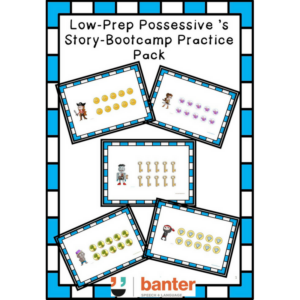 (L263) Low-Prep Possessive ’s Story-Bootcamp Practice Pack
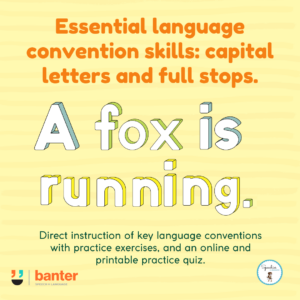 (R702) Essential Language Convention Skills (Capital Letters and Full Stops)
 (R806) Think Then Write Workbook 5: Multi-Paragraph Information Report Writing Foundations
 (R810) Book Hacker: How to read a book to understand it quickly
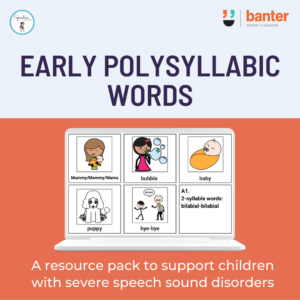 (B210) Early polysyllabic words: a resource pack to support children with severe speech sound disorders
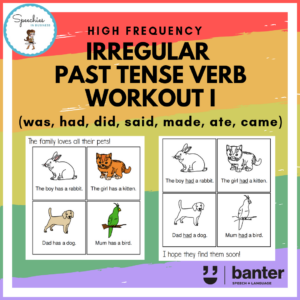 (L132) Verbs: Irregular past tense verb workout 1 (was, had, did, said, made, ate, came)
 (L318) "He's" and "She's" - Contractible Copula and Auxiliary Verbs Mega Workout
 (F514): Roger at the Ranch: A Palatal-Palatal Story
 Speech Therapy by Telehealth (Video Conferencing): Parent Guidelines
 (S120) Speech Fluency & Naturalness Practice-Readings for Students who Stutter: Volume 1 (Nonsense Verses)
 (L111) Subject-Verb (-ing) (Auditory bombardment)
