


(L116) Barrier Activities – Basic English Core Vocabulary: Prepositions
$4.50 including GST
In this 8-page low-prep pack, the barrier stimulus worksheets are designed to help participants develop their Basic English core vocabulary of position words (prepositions). Designed for people learning English as a Second Language, and for children with developmental language disorders, the words depicted in the Barrier Games have been selected from the New General Service List-Spoken 1.2, a list of 721 words accounting for up to 90% of spoken English (Browne & Culligan, 2017, NGSL-S1.2).
Description
Barrier tasks are flexible activities that help kids and adults with communication disorders to demonstrate functional skills requiring clear communication. Barrier tasks can be used for a variety of purposes including helping people learn to speak more clearly, to understand and use language content (e.g. vocabulary, attributes, and categories), understand and use language structures (e.g. morphemes like plurals or possessives, different sentence structures, and following multistep and other complex instructions), and improve their social use of language (e.g. through scaffolded conversations, sequences, and stories).
A barrier activity uses a screen or “barrier” between the speaker and the listener. The barrier can be as simple as a book or folder; or as elaborate as a wall or magnet board. Whatever you use, make sure your barrier prevents the speaker and listener from seeing each other’s work.
Barrier tasks create a need for the speaker to impart clear, relevant messages; and for the listener to listen carefully and to ask for clarification when needed. Barriers can also constrain listeners and speakers by preventing them from using writing, gesture and/or drawing to clarify messages. Constraints like these force speakers and listeners to use – and to practice – their oral language and listening skills; and to develop their theory of mind by learning to put themselves in someone else’s shoes.
In this 8-page low-prep pack, the barrier stimulus worksheets are designed to help participants develop their Basic English core vocabulary of position words (prepositions). Designed for people learning English as a Second Language, and for children with developmental language disorders, the words depicted in the Barrier Games have been selected from the New General Service List-Spoken 1.2, a list of 721 words accounting for up to 90% of spoken English (Browne & Culligan, 2017, NGSL-S1.2).
Principal sources: (1) Ratcliff, A., & Little, M. (1996). A conversation based barrier task approach to teach sight-word vocabulary to a young augmentative communication system user. Child Language Teaching and Therapy, 138. (2) Goral, M. & Kempler, M. (2009). Training verb production in communicative context: Evidence from a person with chronic non-fluent aphasia. Aphasiology, 23(12), 1383.

Related products
-
-

(L101) Barrier Activities – Basic English Core Vocabulary: Nouns 1
$4.50 including GST -
-

(L306) “What is it”? Foundations: Objects in Familiar Environments
$6.99 including GST
 (R612) High Frequency Suffixes for Reading and Writing: "-ible"
 (R423) The Scarecrow and Bear Fair in the Land of Nowhere
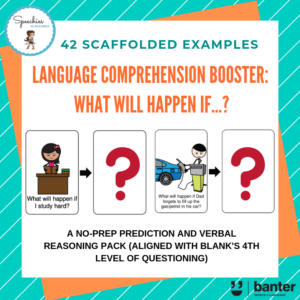 (L404) Blanks 4: Language comprehension booster: What will happen if...?
 (L267) Can I...? Questions (Auditory bombardment)
 (R209) CCVC Words in Sentences: Is Stan a Brat?
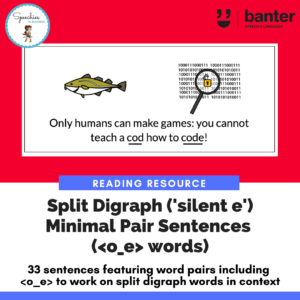 (R310) Reading Resource: Split Digraph ('silent e') Minimal Pair Sentences: o_e words
 (L242) Conjunctions - When (Auditory Bombardment)
 (R305) Decoding Polysyllabic Words in Sentences: My Mother Is Impressive
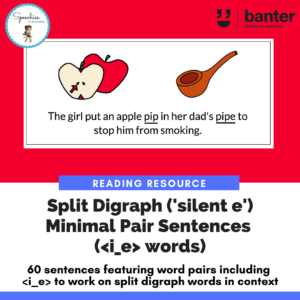 (R309) Reading Resource: Split Digraph ('silent e') Minimal Pair Sentences: i_e words
 Carrier Phrases for Speech, Language, Stuttering and Voice Therapy
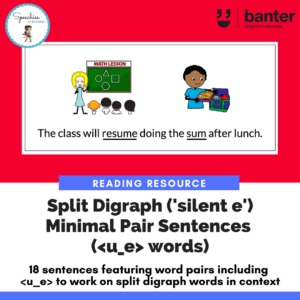 (R311) Reading Resource: Split Digraph ('silent e') Minimal Pair Sentences: u_e words
 Speech Therapy by Telehealth (Video Conferencing): Parent Guidelines
 (R210) Early sound blending practice 5: CVCC words - starting with a continuant
 (L264) The No Prep Grammar Builder: Uncontractible Copulas (“Who’s happy?” “She is!”)
 (L214) Following Directions Workout 1
 (L229) Conjunctions - Because (Auditory bombardment)
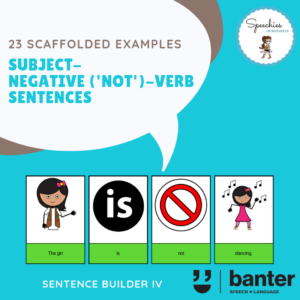 (L124) Subject-Negative ('not')-Verb (SNegV) Sentence Builders
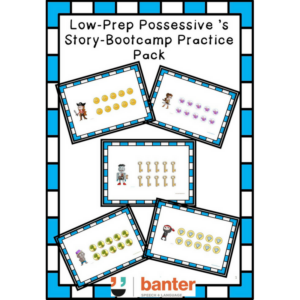 (L263) Low-Prep Possessive ’s Story-Bootcamp Practice Pack
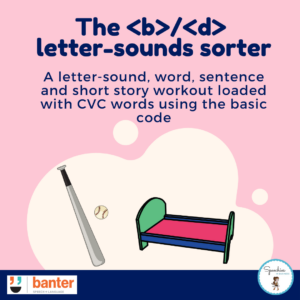 (R206) b/d letter-sounds sorter (a letter-sound, word, sentence and short story workout with CVC words)
 (R216) Early sound blending practice 6: CCVCC words - starting with a continuant
 (R507): Think Then Write Workbook 1: Simple Sentences
 The No-Prep Mumble-Buster: for children who mumble and mutter
 (A100) Sound Cards
 (L215) Following Directions Workout 2
