

(C303) Complexity Approach: True Clusters with a Sonority Difference of 3 (/fl, sl, fr, shr and thr/)
$5.99 including GST
Included in this 27-page (+ 5 audio files) true clusters with a sonority difference of three pack are the following audio files (.mp3) and PDFs:
-
- Part A:
- True clusters with a sonority difference of 3: fl- words (PDF and audio file)
- Minimal Pairs
- Non-word Syllable Bootcamp
- Part B:
- True clusters with a sonority difference of 3: sl- words (PDF and audio file)
- Minimal Pairs
- Non-word Syllable Bootcamp
- Part C:
- True clusters with a sonority difference of 3: fr- words (PDF and audio file)
- Minimal Pairs
- Non-word Syllable Bootcamp
- Part D:
- True clusters with a sonority difference of 3: shr- words (PDF and audio file)
- Minimal Pairs
- Non-word Syllable Bootcamp
- Part E:
- True clusters with a sonority difference of 3: thr- words (PDF and audio file)
- Minimal Pairs
- Non-word Syllable Bootcamp
- Part A:
Description
For children with moderate-severe phonological speech sound disorders, we use three main evidence-based approaches in our clinic:
-
- Cycles;
- Complexity; and
- Contrastive.
These approaches seek to bring about permanent, big changes to a student’s phonological system and to make students more intelligible. They rely on choosing good targets that transfer to other speech sounds without having to work on every speech sound in every word position.
Complexity theory tells us that some consonant sounds are more complex than others. For example:
-
- Three sound clusters (like /spl/, /skw/ and /spr/) are more complex than two sound clusters (like /sl/ and /pr/).
- So-called “small-sonority-difference clusters” like /sm/, /sn/ and /mj/(as is “music”) are more complex than “large-sonority-difference clusters” like /tw/, /kw/ and /pl/.
- True consonant clusters (like /tw/, /pl/, /br/, and /fl/) are more complex than so-called “adjunct clusters” like /sp/, /st/ and /sk/.
- True consonant clusters like /pl/, /sw/ and /fr/ are more complex than affricates like “j” or “ch”.
- Affricates like “j” or “ch” are more complex than fricatives like /f/ or /s/.
- Long, “hissy” sounds called “fricatives” (like /f/ and /s/) are more complex than short “stops” like /p/ and /t/.
- Semi-vowel ‘liquid’ and glide sounds like /l/ and /r/ are more complex than sounds made through your nose, like /n/.
The key idea, here, is that speech pathologists should prioritise speech sound targets that:
-
- are late-acquired developmentally;
- are complex/marked (e.g. targeting fricatives rather than stops, true clusters rather single sounds, clusters with low sonority differences, rather than high (or negative) sonority differences);
- the child doesn’t know/cannot yet produce accurately; and
- the child is not yet stimulable for.
In this pack, we include complex cluster targets. Yes, students need to have some motivation and resilience to give them a go. But we’ve found that working on complex targets – using a Complexity Approach – gives you much more “bang for your buck” than targeting early-developing single consonants in word initial, final and medial positions. In particular, we’ve found that working with complex targets often results in bigger improvements in a student’s general intelligibility.
Included in this 27-page (+ 5 audio files) true clusters with a sonority difference of three pack are the following audio files (.mp3) and PDFs:
-
- Part A:
- True clusters with a sonority difference of 3: fl- words (PDF and audio file)
- Minimal Pairs
- Non-word Syllable Bootcamp
- Part B:
- True clusters with a sonority difference of 3: sl- words (PDF and audio file)
- Minimal Pairs
- Non-word Syllable Bootcamp
- Part C:
- True clusters with a sonority difference of 3: fr- words (PDF and audio file)
- Minimal Pairs
- Non-word Syllable Bootcamp
- Part D:
- True clusters with a sonority difference of 3: shr- words (PDF and audio file)
- Minimal Pairs
- Non-word Syllable Bootcamp
- Part E:
- True clusters with a sonority difference of 3: thr- words (PDF and audio file)
- Minimal Pairs
- Non-word Syllable Bootcamp
- Part A:
To make the tasks more difficult, and to speed up generalisation, combine the targets words with carrier phrases. (You can download our free carrier phrase pack here.)

Related products
-
Sale!
Speech Therapy by Telehealth (Video Conferencing): Parent Guidelines
Original price was: $4.99.$0.00Current price is: $0.00. including GST -

Carrier Phrases for Speech, Language, Stuttering and Voice Therapy
$0.00 including GST -
-

 Australian SLP Private Practice Business Planning Kit including One-Page Business Plan
 (R414) The Zoo Druid
 (C302) Complexity Approach: True Clusters with a Sonority Difference of 2 (/sm/ and /sn/)
 (C301) Complexity Approach: 3-sound clusters (/spl, str, skw, skr and spr/)
 (L311) Blanks 3: Name something that is X that is not Y
 (R307) Reading Resource: Introducing Split Vowel Digraphs
 (L151) "Is" and "Are" (Copula Verb Forms) Sentence Workout
 (L145) Subject-Verb-Object-Adverbial Phrase (SVOA) Sentence Builders
 (L124) Subject-Negative ('not')-Verb (SNegV) Sentence Builders
 (L134) Verbs: Irregular Past Tense Verb Workout 3 (spent, sent, left, built)
 (R310) Reading Resource: Split Digraph ('silent e') Minimal Pair Sentences: o_e words
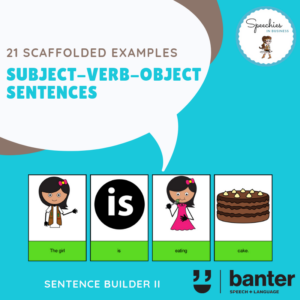 (L119) Subject-Verb-Object (SVO) Sentence Builders
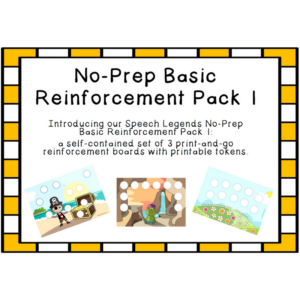 No-Prep Basic Reinforcement Pack I
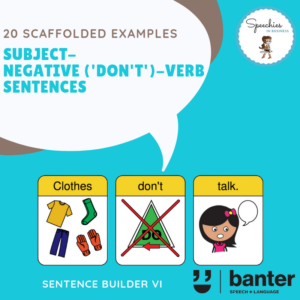 (L126) Subject-Negative ('Don't')-Verb (SNegV Don't) Sentence Builders
 Social Media Platform House Rules
 (F519) Advanced Speech Sound Exercises: Discourse Level Exercises - Alveolar Speech Sounds
