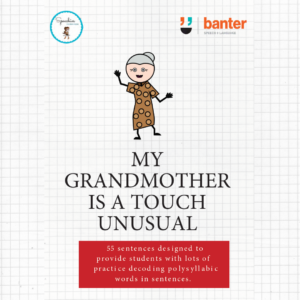


(R306) Decoding Polysyllabic Words in Sentences: My Grandmother Is a Touch Unusual
$4.99 including GST
Many students with reading difficulties struggle with long words – especially words with two or more syllables (‘polysyllables’). For example, many children will look at a long word and simply guess at the word, e.g. by looking at the first letter or by guessing at the word by looking at the accompanying pictures.
To make the work meaningful – and to work on reading fluency at the same time – we like to teach students how to read polysyllables using real words in sentences.
This resource contains 55 sentences designed to provide students with lots of practice decoding polysyllabic words in sentences.
Description
Many students with reading difficulties struggle with long words – especially words with two or more syllables (‘polysyllables’). For example, many children will look at a long word and simply guess at the word, e.g. by looking at the first letter or by guessing at the word by looking at the accompanying pictures.
The benefits of working on polysyllabic words early
In our experience, it’s a good idea to work on polysyllabic words as soon as possible – before ‘guessing’ becomes a default strategy or habit. We start work on polysyllables as soon as students have mastered:
- the basic code (linked a common speech sound to each letter of the alphabet);
- high frequency digraphs, like <th>,<sh>, <ch>, and <ng>;
- consonant-vowel-consonant (CVC) words;
- consonant-consonant-vowel-consonant (CCVC) words; and
- consonant-vowel-consonant-consonant (CVCC) words.
We usually start teaching students how to decode polysyllabic words in parallel with teaching them how to read split digraphs (sometimes called the ‘bossy’, ‘magic’ or ‘silent’ <e>) (e.g. <a_e>, <i_e>, <o_e>, <u_e> words) and the extended code (e.g. <oa>, <ee>, <ow>, <ay>).
To make the work meaningful – and to work on reading fluency at the same time – we like to teach students how to read polysyllables using real words in meaningful sentences.
This resource contains 55 sentences designed to provide students with lots of practice decoding polysyllabic words in sentences.
It is a companion to ‘My Dad does several silly things‘ and ‘My Mother is Impressive‘ – other resources that you can use to practice reading polysyllabic words in sentences.
More information and resources
For free, evidence based on effective reading instruction, check out these articles:
- Is your child struggling to read? Here’s what works
- Too many children can’t read. We know what to do, but how should we do it?
For free, decodable stories focusing on the basic code, check out: Is your Kindy kid really reading? Find out with our 7 free mini stories
For our ‘Select-your-Sequel’ adventure series of decodable texts for 7-12 year-olds focusing on the extended code and reading fluency – including the free first book – check out The Scatter-Slayer Adventures.

Related products
-

-
-
Sale!

Speech Therapy by Telehealth (Video Conferencing): Parent Guidelines
Original price was: $4.99.$0.00Current price is: $0.00. including GST -
 (L105) Pronouns: The No Prep Verb & Pronoun Workout (short sentence level)
 (L211) Pronouns: Him and Her Sentence Builders (Objective Pronouns)
 (L212) His and Her Sentence Builders and Bingo Game
 (L264) The No Prep Grammar Builder: Uncontractible Copulas (“Who’s happy?” “She is!”)
 (L229) Conjunctions - Because (Auditory bombardment)
 Carrier Phrases for Speech, Language, Stuttering and Voice Therapy
 (L129) Subject-Verb-Complement (Auditory Bombardment)
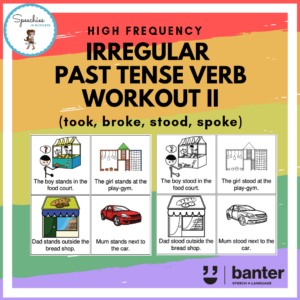 (L133) Verbs: Irregular Past Tense Verb Workout 2 (took, broke, stood, spoke)
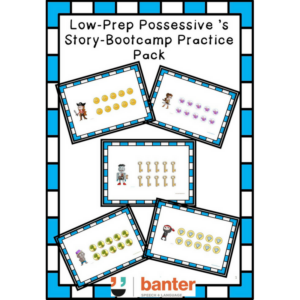 (L263) Low-Prep Possessive ’s Story-Bootcamp Practice Pack
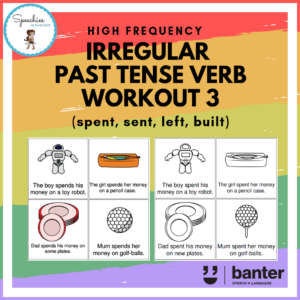 (L134) Verbs: Irregular Past Tense Verb Workout 3 (spent, sent, left, built)
 (L111) Subject-Verb (-ing) (Auditory bombardment)
 No-Prep Basic Reinforcement Pack I
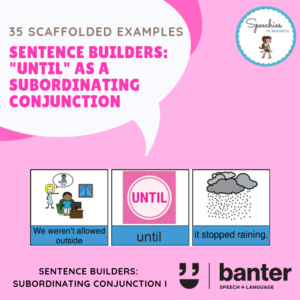 (L250) Sentence builders: "Until" as a Subordinating Conjunction
 (L242) Conjunctions - When (Auditory Bombardment)
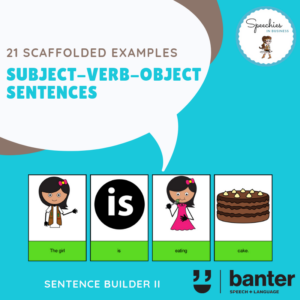 (L119) Subject-Verb-Object (SVO) Sentence Builders
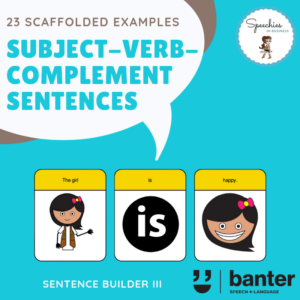 (L128) Subject-Verb-Complement (SVC) Sentence Builders
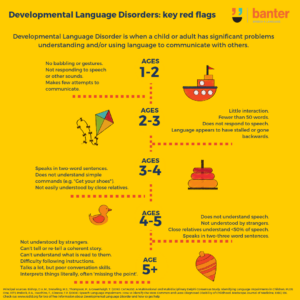 Developmental Language Disorder: Key Red Flags
 (R209) CCVC Words in Sentences: Is Stan a Brat?
 (L126) Subject-Negative ('Don't')-Verb (SNegV Don't) Sentence Builders
 (B210) Early polysyllabic words: a resource pack to support children with severe speech sound disorders
 (E414) A /k/-initial aspiration trick story (for velar fronting and /k/ articulation)
 (F501) The Wolf Matthew, the Beaver, and the Moth: A Bilabial-Dental Story
 (A100) Sound Cards
 (L267) Can I...? Questions (Auditory bombardment)
 (F513): Chief Shoshone and A Palatal Thriller: Palatal-Palatal Stories
 (F514): Roger at the Ranch: A Palatal-Palatal Story
 (R206) b/d letter-sounds sorter (a letter-sound, word, sentence and short story workout with CVC words)