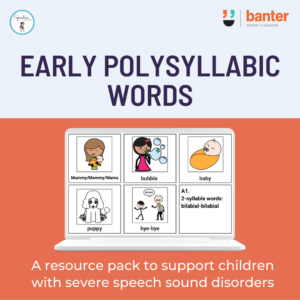
(B210) Early polysyllabic words: a resource pack to support children with severe speech sound disorders
$5.99 including GST
In this 17-page pack, we introduce early two, three, and four syllable words. We chose the target words:
-
- from functional and common English words identified in the Semantic Networks for children aged 21-36 months of age, as reported by Wordbank: An open database of children’s vocabulary development, which contains data from over 75,000 young children; and
- with a preference for early acquired consonants, including bilabial speech sounds (e.g. /p, b, m/); and early alveolar speech sounds (e.g. /d, n, t/). These speech sounds are typically acquired by around the age of 3 years.
Description
Between the ages of 2 and 3 years, most children learn to say words consisting of more than one syllable – also known as polysyllabic words. Some children need some extra help to say polysyllabic words, including some children with severe speech sound disorders. You can read more about speech sound disorders here.
In this 17-page pack, we introduce early two, three, and four syllable words. We chose the target words:
-
- from functional and common English words identified in the Semantic Networks for children aged 21-36 months of age, as reported by Wordbank: An open database of children’s vocabulary development, which contains data from over 75,000 young children; and
- with a preference for early acquired consonants, including bilabial speech sounds (e.g. /p, b, m/); and early alveolar speech sounds (e.g. /d, n, t/). These speech sounds are typically acquired by around the age of 3 years. (For more on this, please see our article: In what order and at what age should my child learn to say his/her consonants? FAQs.)
This resource can be used with young children with severe speech sound disorders, e.g. as an early target following a Cycles Approach. It can also be used with children with severe childhood apraxia of speech, e.g. as part of a DTTC treatment program, recognising that, before children have around 50 words in their expressive vocabularies, their consonant inventories and speech sound systems may be limited and unstable.


 (L273) Sentence builders: "Although" as a Subordinating Conjunction
 No-Prep Basic Reinforcement Pack I
 (F505) The Theatre Folk: A Dental-Alveolar Story
 (L106) Pronouns: He/She - Subjective Pronouns No-Prep Workout Pack
 (F513): Chief Shoshone and A Palatal Thriller: Palatal-Palatal Stories
 (R401) Extended Code: A Gloomy Day In My Room For Yet More Zoom Doom! A Silly 'oo' Sentence Story Workout
 (L143) Pronouns: No Prep Subjective Pronoun (I, you, he, she, they) + has/have Pack
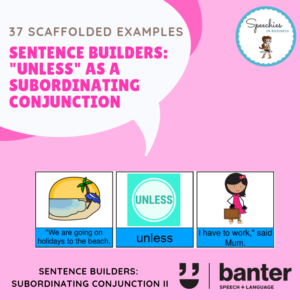 (L246) Sentence builders: "Unless" as a Subordinating Conjunction
 (R305) Decoding Polysyllabic Words in Sentences: My Mother Is Impressive
 (S115) Stuttering and fluency wellness snapshot for school-aged children who stutter
 (L235) Complex sentence picture description task: 'if' and 'while' sentences
 (S125) Speech Fluency & Naturalness Practice-Readings for Students and Adults who Stutter: Volume 6 (Famous Essays)
 Carrier Phrases for Speech, Language, Stuttering and Voice Therapy
 (S118) Picture Description Resources for Stuttering Therapy (Volume 2)
 (S122) Speech Fluency & Naturalness Practice-Readings for Students who Stutter: Volume 3 (Poems)
 (S107) Lidcombe Program Starter Series: Resources for Highly Structured Practice: Say What I Say
 (R213) CVC and CCVC Words: Voiceless stops (/p, t, k/) vs voiced stops (/b, d, g/)
 (C304) Complexity Approach: True Clusters with a Sonority Difference of 4 (/sw, bl, gl, br, dr, gr/)
 (F519) Advanced Speech Sound Exercises: Discourse Level Exercises - Alveolar Speech Sounds
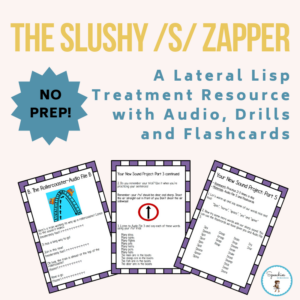 (E411) Slushy /s/ Zapper: A Lateral Lisp Treatment Resource
 (E414) A /k/-initial aspiration trick story (for velar fronting and /k/ articulation)