

(L201) Blanks 2: Find the one that is X and Y
$5.99 including GST
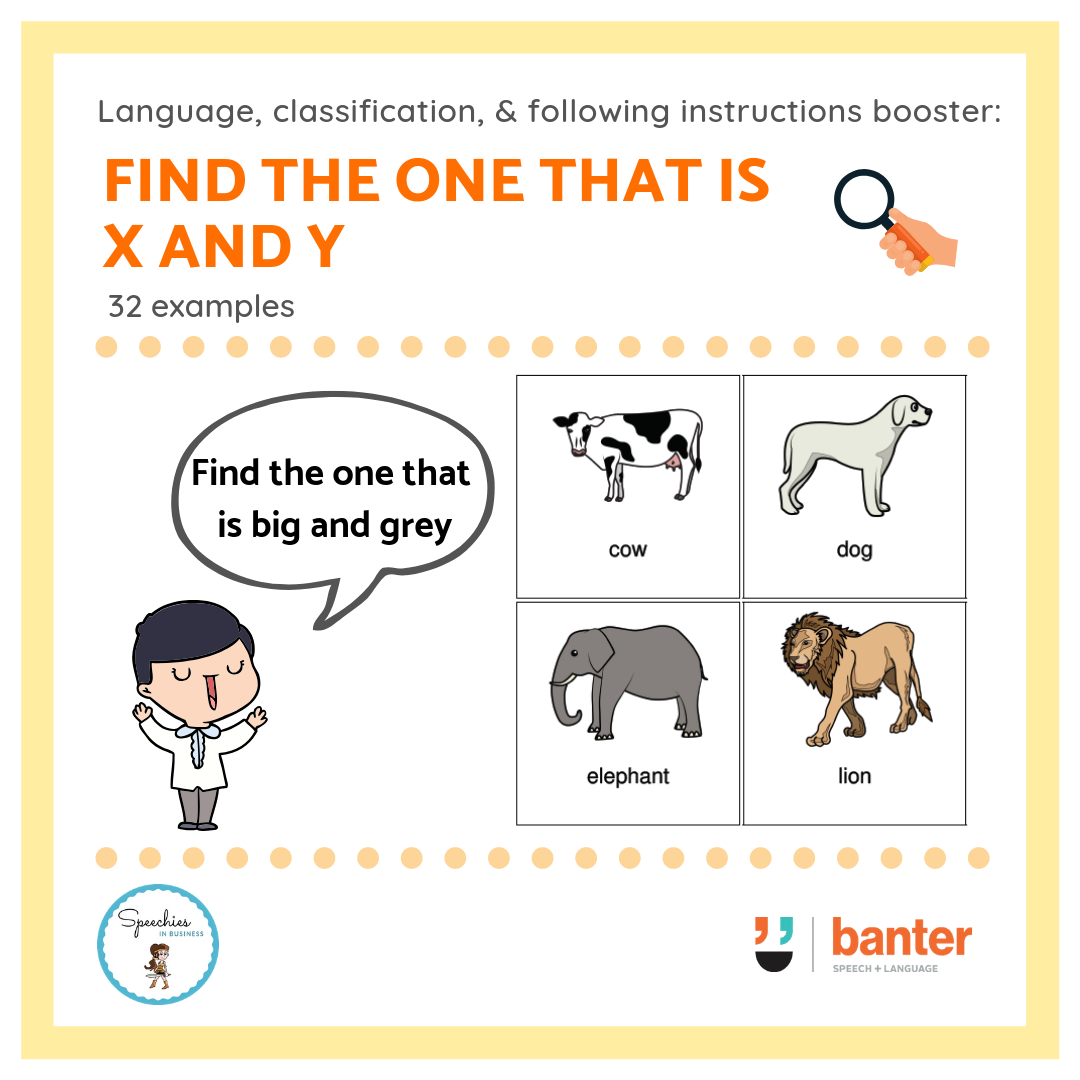
In this 39-page no-prep pack, we target a Blank’s Level 2 comprehension task. Specifically, we ask students to identify objects by two given attributes. This work can also help children to follow instructions, and to build their semantic knowledge by helping children distinguish and to identify objects by multiple attributes.
Description
Some researchers think that up to 15% of young school kids don’t have the language comprehension skills to cope fully with the demands of school (Hart & Fielding-Barnsley, 2009). Many of these kids struggle – some for their whole lives. For most kids, school and home life plays a big role in helping to understand and use language (Morgan & Goldstein, 2004; Nation, 2005). So what can we do to improve students’ understanding of language?
Well, it helps to have a plan. And good plans are based on tried and tested frameworks. For language comprehension, one of the most influential frameworks was developed by Dr Marion Blank, a developmental psychologist. Dr Blank proposed four levels of abstraction, from least to most abstract:
Level 1: Directly supplied information (Matching perception)
Level 2: Classification
Level 3: Reorganisation
Level 4: Abstraction and Inferences
Many kids start school with an ability to complete Level 1 and 2 tasks. But some don’t; and many students with limited language skills really struggle with verbs of function – naming the action performed by a given part, which can hamper oral language development and reading comprehension skills.
In this 39-page no-prep pack, we target a Blank’s Level 2 comprehension task. Specifically, we ask students to identify objects by two given attributes. This work can also help children to follow instructions, and to build their semantic knowledge by helping children distinguish and to identify objects by multiple attributes.
This exercise can be completed in any language. To make the exercise more challenging, ask the student to name two or three members of each group.

 (R415) Attack of the Eel Beast
 Speech Therapy by Telehealth (Video Conferencing): Parent Guidelines
 (R417) The Frightening Shy Child
 (R209) CCVC Words in Sentences: Is Stan a Brat?
 (R413) The Scatter-Slayer Adventures: Book 1 – Don’t Stay! Be Afraid!
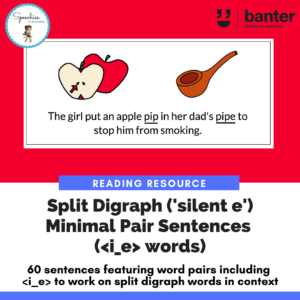 (R309) Reading Resource: Split Digraph ('silent e') Minimal Pair Sentences: i_e words
 (R306) Decoding Polysyllabic Words in Sentences: My Grandmother Is a Touch Unusual
 No-Prep Basic Reinforcement Pack I
 (C304) Complexity Approach: True Clusters with a Sonority Difference of 4 (/sw, bl, gl, br, dr, gr/)
 (R213) CVC and CCVC Words: Voiceless stops (/p, t, k/) vs voiced stops (/b, d, g/)
 (E411) Slushy /s/ Zapper: A Lateral Lisp Treatment Resource
 (R419) The Shark Arcade
 (R215) Early Reading Workout - Stan has three cats: Dom, Don and Dan (CVC, CVCC, CCVC)
 (R701) NAPLAN: Year 3 - Essential Language Convention Skills for NAPLAN (Nouns and Proper Nouns)
 (R806) Think Then Write Workbook 5: Multi-Paragraph Information Report Writing Foundations
 (R702) Essential Language Convention Skills (Capital Letters and Full Stops)
 (R214) CVCC Words in Sentences: Wendy has zest!
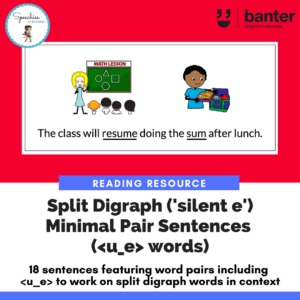 (R311) Reading Resource: Split Digraph ('silent e') Minimal Pair Sentences: u_e words
 (R418) The Blue-Bruised Newt
 (R308) Reading Resource: Split Digraph ('silent e') Minimal Pair Sentences: a_e words
