


(L516) Informative text language workout for primary school students: Ants and Spiders
$6.99 including GST
In this 30-page informative text language workout, we target:
- oral and written language exercises about the world around us;
- Tier 2 vocabulary;
- semantic feature analysis;
- compound and complex sentences;
- informative text macrostructure;
- problem solving;
- world knowledge; and
- inferencing and verbal reasoning.
All around the interesting topic of ants and spiders!
Description
Knowledge of the structure and language of non-fiction books is critical to later reading achievement. For example, a preschooler’s ability to produce well-organised, informational and detailed picture descriptions account for almost a quarter of the variance in reading comprehension scores at 8 years of age (Griffin et al., 2004).
Young typically-developing kids and at-risk school-age kids have been shown to be capable of understanding non-fiction books (e.g. Culatta et al., 2010).
Some young kids – including lots of boys – are not into picture books. Lots of my young clients would prefer to ‘read’ about dinosaurs, cars, Rugby League or the Battle of Hastings than about dragons, flying broomsticks, Quidditch or the Avengers Infinity War (though it’s of course possible to love both).
Children are likely to learn more if they are interested in the topic. This is especially true of preschool children with language learning disorders who are six times more likely to be identified with a later reading disability at school-age than peers who do not have language disorders (Catts et al., 2002).
The right non-fiction texts can be just as useful as stories for teaching kids pre-literacy skills like print awareness, phonological awareness, and vocabulary.
The right non-fiction text can provide a language ‘workout’ by:
- requiring children to process and use complex syntax such as compound and complex sentences e.g. when discussing explanations, predictions and cause-effect relationships. Many kids with language disorders have problems in these areas, even if their IQ is in the normal range (Tomblin et al., 1997);
- helping kids to learn academic and so-called Tier 2 or ‘Power’ words – words they are unlikely to hear in spoken conversation, but are likely to encounter across many subjects at school (you can see a list here);
- helping kids to acquire background knowledge about the world, e.g. that most plants need sunlight and water to live; and
- provide facts, e.g. on science concepts, that can help children link new vocabulary to their real world experiences.
In this 30-page informative text language workout, we target:
- oral and written language exercises about the world around us;
- Tier 2 vocabulary;
- semantic feature analysis;
- compound and complex sentences;
- informative text macrostructure;
- problem solving;
- world knowledge; and
- inferencing and verbal reasoning.
Children are given multiple opportunities to learn and share knowledge about ants and spiders, use vocabulary related to ants and spiders, answer comprehension questions, and set a real-world mission.
The workout is designed to encourage students to link their world knowledge and experiences to the vocabulary and sentence structures modelled in the workout.
Key source: Breit-Smith, A., Olszewski, A., Swoboda, C., Guo, Y and Prendeville, J.A. (2017). Sequence text structure intervention during interactive book reading of expository picture books with preschool children with language impairment. Child Language Teaching & Therapy 33(3) 287-304.

 (R612) High Frequency Suffixes for Reading and Writing: "-ible"
 (R423) The Scarecrow and Bear Fair in the Land of Nowhere
 (L404) Blanks 4: Language comprehension booster: What will happen if...?
 (L267) Can I...? Questions (Auditory bombardment)
 (R209) CCVC Words in Sentences: Is Stan a Brat?
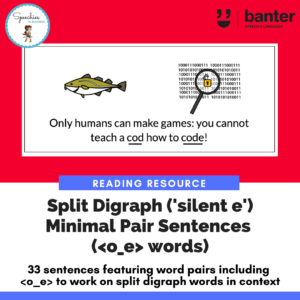 (R310) Reading Resource: Split Digraph ('silent e') Minimal Pair Sentences: o_e words
 (L242) Conjunctions - When (Auditory Bombardment)
 (L101) Barrier Activities - Basic English Core Vocabulary: Nouns 1
 (R305) Decoding Polysyllabic Words in Sentences: My Mother Is Impressive
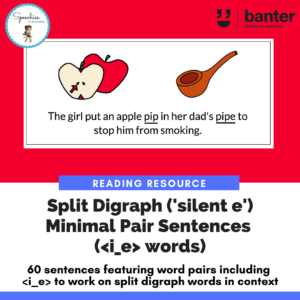 (R309) Reading Resource: Split Digraph ('silent e') Minimal Pair Sentences: i_e words
 Carrier Phrases for Speech, Language, Stuttering and Voice Therapy
 (L144) Barrier Activities - Basic English Core Vocabulary: Pronouns and People
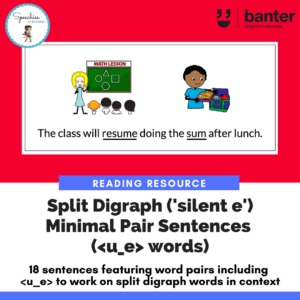 (R311) Reading Resource: Split Digraph ('silent e') Minimal Pair Sentences: u_e words
 Speech Therapy by Telehealth (Video Conferencing): Parent Guidelines
 (R210) Early sound blending practice 5: CVCC words - starting with a continuant
 (L214) Following Directions Workout 1
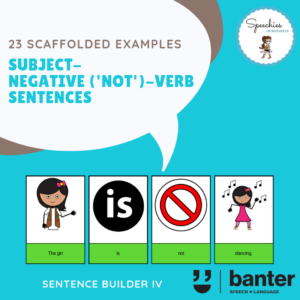 (L124) Subject-Negative ('not')-Verb (SNegV) Sentence Builders
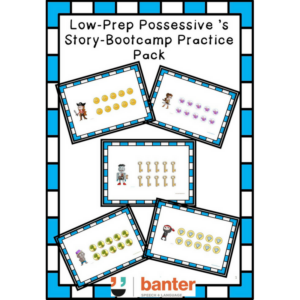 (L263) Low-Prep Possessive ’s Story-Bootcamp Practice Pack
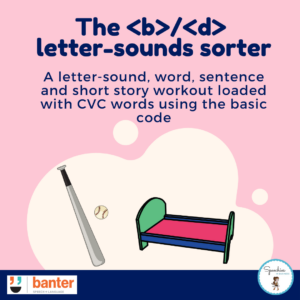 (R206) b/d letter-sounds sorter (a letter-sound, word, sentence and short story workout with CVC words)
 (R216) Early sound blending practice 6: CCVCC words - starting with a continuant
 (R507): Think Then Write Workbook 1: Simple Sentences
 The No-Prep Mumble-Buster: for children who mumble and mutter
 (A100) Sound Cards
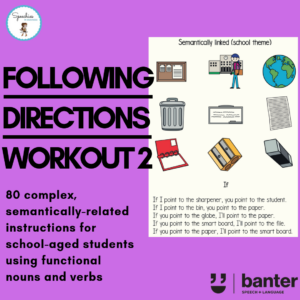 (L215) Following Directions Workout 2
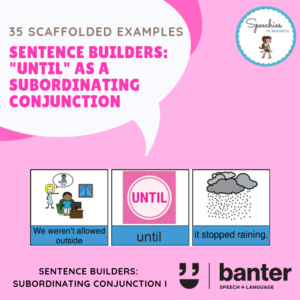 (L250) Sentence builders: "Until" as a Subordinating Conjunction
 (L120) Subject-Verb-Object (SVO) Sentence Builders Volume 2
 Motor-speech stories for articulation movements pack 3: alveolar-alveolar and velar-velar
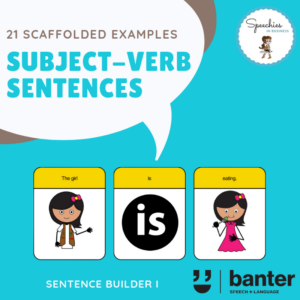 (L109) Subject-Verb (SV) Sentence Builders
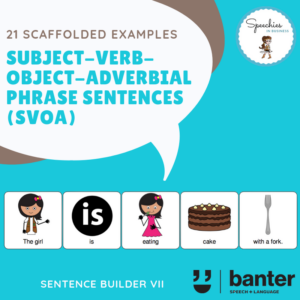 (L145) Subject-Verb-Object-Adverbial Phrase (SVOA) Sentence Builders
