


(L320) Relative Clause Sentence Workout: That
$5.99 including GST
Between the ages of 4-5 years of age, typically developing children start to form sentences containing relative clauses (Barako Arndt & Schuele (2013)).
A relative clause is a subordinate clause that specifies or gives information about a person or a thing. They come after nouns or pronouns; and often begin with a relative pronoun such as ‘who’, ‘that’, or ‘which’.
In this 13-page resource, we provide lots of structured practice with relative clauses starting with ‘that’. The resource features pictures and words and shows relative clauses in the context of sentences.
Description
Between the ages of 4-5 years of age, typically developing children start to form sentences containing relative clauses (Barako Arndt & Schuele (2013)). A relative clause is a subordinate clause that specifies or gives information about a person or a thing. They come after nouns or pronouns; and often begin with a relative pronoun such as ‘who’, ‘that’, or ‘which’. For example:
- The librarian who was saving up for a car caught the bus to work every weekday.
- The snake that had the yellow spots and red stripes was highly venomous.
- The lawnmower, which is in the garage, needs a service.
Many children need to understand and use sentences containing relative clauses – including some children with developmental language and learning disorders, and some people learning English as a second language. This resource is designed to give children lots of practice with relative clauses in sentences.
In this 13-page resource, we provide lots of structured practice with relative clauses starting with ‘that’. The resource features pictures and words and shows relative clauses in the context of sentences. It is suitable for use with children and adults.
In our speech pathology clinic, we have found this resource useful. We hope you do too!

Related products
-
-
-
-
(L126) Subject-Negative (‘Don’t’)-Verb (SNegV Don’t) Sentence Builders
$5.99 including GST
 No-Prep Basic Reinforcement Pack I
 (L313) Blanks 3 Bundle: Language Comprehension Booster - Verbal Reasoning Tasks
 (L302) Blanks 2 and 3 Dinosaurs Picture Resource
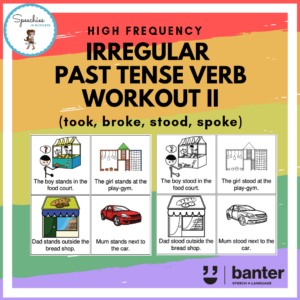 (L133) Verbs: Irregular Past Tense Verb Workout 2 (took, broke, stood, spoke)
 (L324) Blanks 3 and 4 Picture Resource
 (L502) Listen then Speak 2: an oral language workout for students in Years 2-5
 Word Learner
 (R601) High Frequency Prefixes for Reading and Writing: "Un-"
 (L129) Subject-Verb-Complement (Auditory Bombardment)
 (S128) Speech Fluency & Naturalness Practice for Students and Adults who Stutter: Volume 7 (Impromptu Speaking Discussion Topics)
 (R607) High Frequency Prefixes for Reading and Writing: "In-"
 (L242) Conjunctions - When (Auditory Bombardment)
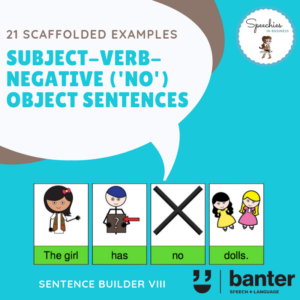 (L123) Subject Verb Negative ("No") Object (SVNegO) Sentences
 (S117) Picture Description Resources for Stuttering Therapy (Volume 1)
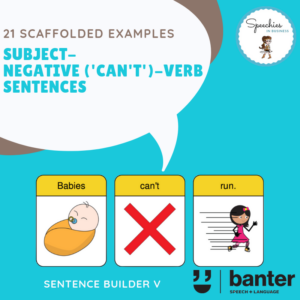 (L125) Subject-Negative ('Can't')-Verb (SNegV Can't) Sentences
