

(L205) Blanks 2: Tell me something that is a/an….?
$5.99 including GST
In this 25-page no-prep pack, we target a Blank’s Level 2 comprehension task. Specifically, we ask students to name members of common categories. This work can also help children to classify things and to build their semantic knowledge by helping them classify objects by category or groups.
Description
Some researchers think that up to 15% of young school kids don’t have the language comprehension skills to cope fully with the demands of school (Hart & Fielding-Barnsley, 2009). Many of these kids struggle – some for their whole lives. For most kids, school and home life plays a big role in helping to understand and use language (Morgan & Goldstein, 2004; Nation, 2005). So what can we do to improve students’ understanding of language?
Well, it helps to have a plan. And good plans are based on tried and tested frameworks. For language comprehension, one of the most influential frameworks was developed by Dr Marion Blank, a developmental psychologist. Dr Blank proposed four levels of abstraction, from least to most abstract:
Level 1: Directly supplied information (Matching perception)
Level 2: Classification
Level 3: Reorganisation
Level 4: Abstraction and Inferences
Many kids start school with an ability to complete Level 1 and 2 tasks. But some don’t; and many students with limited language skills really struggle with verbs of function – naming the action performed by a given part, which can hamper oral language development and reading comprehension skills.
In this 25-page no-prep pack, we target a Blank’s Level 2 comprehension task. Specifically, we ask students to name members of common categories. This work can also help children to classify things and to build their semantic knowledge by helping them classify objects by category or groups.
This exercise can be completed in any language. To make the exercise more challenging, ask the student to name two or three more things in the group.

 Social Media Platform House Rules
 Reference Letter Templates
 Letter of Introduction to Educators
 Business Networking Letters
 (N106) Code of Conduct for NDIS Providers and Health Providers
 (N107) NDIS Service Agreement Template 2025-26
 Australian SLP Private Practice Business Planning Kit including One-Page Business Plan
 Client Intake Form
 From Launch to Waitlist
 Letter of thanks to client
 Mentor Meeting Agenda
 Letter turning down a client (politely)
 Letter of Introduction to Doctors
 Progress Note System (Therapy)
 Weekly Session Planner
 Session Plan and Data Collection Worksheet
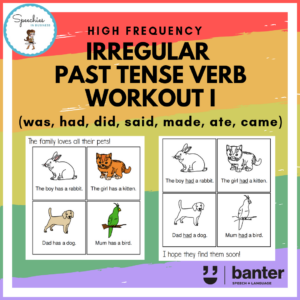 (L132) Verbs: Irregular past tense verb workout 1 (was, had, did, said, made, ate, came)
