


(L306) “What is it”? Foundations: Objects in Familiar Environments
$6.99 including GST
Semantic feature analysis – describing objects by key attributes – is an evidence-based strategy to learn new vocabulary and word meanings. It can deepen students’ understanding of words they already know. The strategy can also help children with word-finding or other language or learning difficulties, e.g. by giving them a way of describing what they mean when they can’t find the word.
This no-preparation 69-page pack is designed to help students of all abilities to learn the strategy of semantic feature analysis in the context of objects that they are likely to encounter “in the real world”.
To make it accessible to all students, we have chosen easily pictured objects from common environments in which young children participate in everyday activities.
Description
“What is it?” Foundations: Objects in Familiar Environments. A no-prep, 10-theme, accessible, story-based description program using evidence-based semantic feature analysis (aligned with Blank’s 3rd Level of Questioning)
In late preschool and in the early years of school, we want students to learn to look beyond what they see and to rework their experiences using language. One way to help children to do this is to teach them to describe the information they see by reference to key attributes – the qualities or features regarded as characteristic or as inherent parts – of the things around them.
Semantic feature analysis – describing objects by key attributes – is an evidence-based strategy to learn new vocabulary and word meanings. It can deepen students’ understanding of words they already know. The strategy can also help children with word-finding or other language or learning difficulties, e.g. by giving them a way of describing what they mean when they can’t find the word.
This 69-page no-preparation pack is designed to help students of all abilities to learn the strategy of semantic feature analysis in the context of objects that they are likely to encounter “in the real world”.
To make it accessible to all students, we have chosen easily pictured objects from common environments in which young children participate in everyday activities. We have selected attributes that we have found clinically to be of the greatest use in describing, defining and understanding common objects, namely:
- function (what you do with it, or what it does);
- location (where you find it);
- object parts (to help students to look closely at objects);
- colour;
- size; and
- category/group (to stimulate semantic knowledge and associations between objects).
With a scripted introduction, a colourful scaffold, and 50 examples, this pack is designed to give students plenty of structured practice describing common objects. Once completed, students can use the scaffold to describe any object, including curriculum specific nouns.
For more information and free resources about vocabulary support and instruction, check out our article: How to help your school-age child to learn new words: the nuts and bolts of how I actually do it in therapy.
For more semantic feature analysis resources, check out our:
- What is it? Semantic feature analysis – describing objects by key attributes;
- School readiness and early school vocabulary: “What is it?” (Blanks 3) resource; and
- Action Describer: Verb-Description Program Using Semantic Feature Analysis.

Related products
-
-
-
-
(L112) Barrier Activities – Basic English Core Vocabulary: Verbs 1
$4.50 including GST
 (S127) Lidcombe Program Starter Series: Highly Structured Practice Bundle
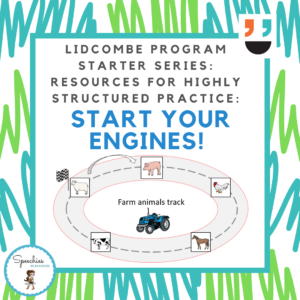 (S108) Lidcombe Program Starter Series: Resources for Highly Structured Practice: Start Your Engines!
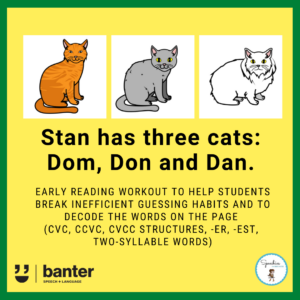 (R215) Early Reading Workout - Stan has three cats: Dom, Don and Dan (CVC, CVCC, CCVC)
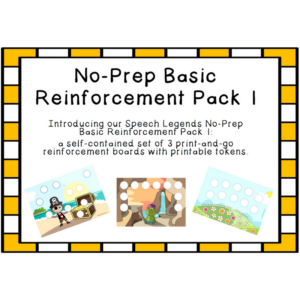 No-Prep Basic Reinforcement Pack I
 (L229) Conjunctions - Because (Auditory bombardment)
 (R702) Essential Language Convention Skills (Capital Letters and Full Stops)
 (F515) Roger and the Magic Ring: A Palatal-Velar Story
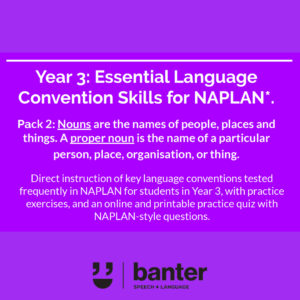 (R701) NAPLAN: Year 3 - Essential Language Convention Skills for NAPLAN (Nouns and Proper Nouns)
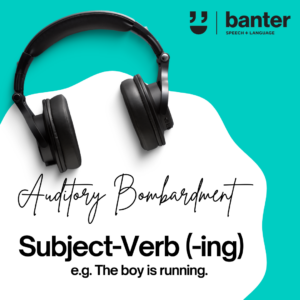 (L111) Subject-Verb (-ing) (Auditory bombardment)
 Client Intake Form
 (L301) Barrier Tasks for Receptive Language, Vocabulary and Language Structures
