
(L149) Plurals: Practising Irregular Plural Nouns -es
$6.99 including GSTThis 28-page pack is designed to give people lots of focused practice distinguishing singular and plural forms of nouns ending in <s>, <z>, <ch>, <j> or <x> by adding <-es> (/əz/) to the plural form. For example, we say two “buses”, “sneezes”, “beaches”, “bridges”, and “foxes”. These are irregular plurals because they deviate from standard practice of simply adding a -s to the end of a noun, as with many nouns in English that end with different consonants (e.g. “labs”, “legs”, “snails”, etc.).
To help promote transfer to everyday activities, we’ve included a short “eye spy” activity, which you can tailor to encourage more practice in plural nouns ending in <-es> (/əz/).
Finally, the nouns are included on cards at the end of the pack, which you can laminate and/or cut up for sorting games.
 (E414) A /k/-initial aspiration trick story (for velar fronting and /k/ articulation)
 (A112) Speech Sound Pack (Initial, Medial and Final) - /f/
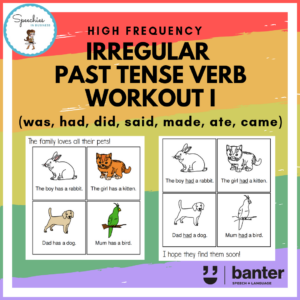 (L132) Verbs: Irregular past tense verb workout 1 (was, had, did, said, made, ate, came)
 Carrier Phrases for Speech, Language, Stuttering and Voice Therapy
 (R701) NAPLAN: Year 3 - Essential Language Convention Skills for NAPLAN (Nouns and Proper Nouns)
 (L153) Verbs in Action 3: GIF-based video models of simple, compound and complex sentences
 (L121) Subject-Verb-Object (-ing) (Auditory Bombardment)
 (L136) Verbs: Irregular Past Tense Verb Workout 5 (slept, went, meant)
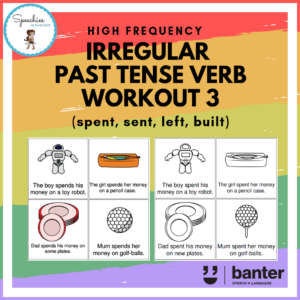 (L134) Verbs: Irregular Past Tense Verb Workout 3 (spent, sent, left, built)
 (L111) Subject-Verb (-ing) (Auditory bombardment)
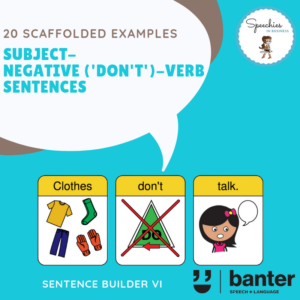 (L126) Subject-Negative ('Don't')-Verb (SNegV Don't) Sentence Builders
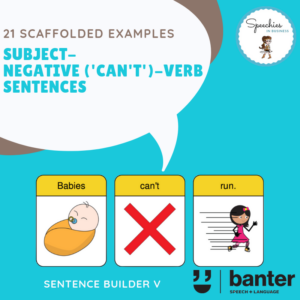 (L125) Subject-Negative ('Can't')-Verb (SNegV Can't) Sentences
 (R417) The Frightening Shy Child
 (R418) The Blue-Bruised Newt
 (L308) Blanks 3: What will happen next?