
(R615) Essential Language Convention Skills 3: How to Use Quotation Marks Properly
$6.99 including GSTIn this 31-page Teach-Practice-Test resource, we do six things:
-
- Explain what quotation marks are (including alternative names like “inverted commas” and “quote marks”).
- Teach students how to use quotation marks, and where to place commas.
- Show students how yo use quotation marks for quotations and direct speech.
- Clarify the conventional use of single and double quotation marks in Australia, the UK and the United States.
- Explain how to punctuate quotations within quotations.
- Outline rules for placing commas, full stops, quotation marks, and for quoting longer passages and punctuating broken quotations.
It can be downloaded as a PDF or in Google Slides format. The slides can be used one-to-one, in small groups, and in whole class instruction.
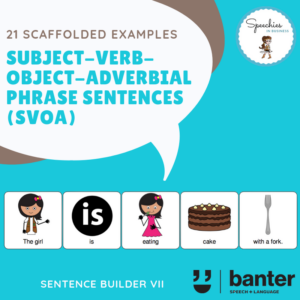 (L145) Subject-Verb-Object-Adverbial Phrase (SVOA) Sentence Builders
 (D406) Weak Syllable Deletion Pack
 (L129) Subject-Verb-Complement (Auditory Bombardment)
 (L121) Subject-Verb-Object (-ing) (Auditory Bombardment)
 (D405) Stopping Pack
 Complex Cluster Targets for use with a Cycles Approach, Complexity Approach or Contrastive Approach
 (L264) The No Prep Grammar Builder: Uncontractible Copulas (“Who’s happy?” “She is!”)
 (D408) Deaffrication Pack
 (L109) Subject-Verb (SV) Sentence Builders
 Word Learner
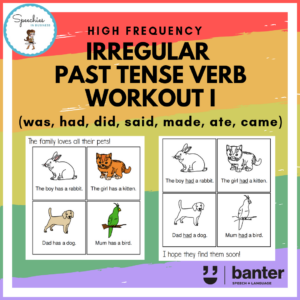 (L132) Verbs: Irregular past tense verb workout 1 (was, had, did, said, made, ate, came)
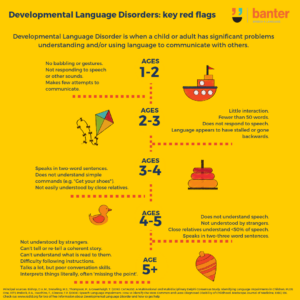 Developmental Language Disorder: Key Red Flags
 (B206) Cycles Approach: Velars Pack (/k/ initial and final, /g/ initial)
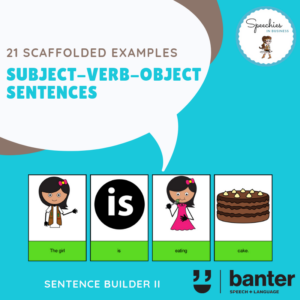 (L119) Subject-Verb-Object (SVO) Sentence Builders
 (C305) Complexity Approach: True Clusters with a Sonority Difference of 5 (/kl, pl, kr, pr, tr/)