


(R208) CVC/CCVC minimal pairs and near minimal pairs contrasted in short sentences
$4.99 including GST
Once our students have learned to decode and encode simple Consonant-Vowel-Consonant (CVC) and Consonant-Consonant-Vowel-Consonant (CCVC) words composed of letters in the basic code – but before we step up to working on polysyllabic words, we recommend that students practice decoding short sentences containing similar words that contrast CVC and CCVC word pairs, e.g. <tick> v <stick>.
In this early reading support resource we feature 32 decodable CVC/CCVC minimal pairs and near minimal pairs contrasted in short sentences.
Description
Early reading support: 32 decodable CVC/CCVC minimal pairs and near minimal pairs contrasted in short sentences (e.g. The man hit the big tick with a stick.”)
Learning to decode letters into speech sounds, and then to blend the speech sounds together to form words is a fundamental reading skill for all students in their first year of schooling.
Once our students have learned to decode and encode simple Consonant-Vowel-Consonant (CVC) and Consonant-Consonant-Vowel-Consonant (CCVC) words composed of letters in the basic code – but before we step up to working on polysyllabic words, we recommend that students practice decoding short sentences containing similar words that contrast CVC and CCVC word pairs, e.g. <tick> v <stick>.
These exercises are also useful for students who may speak with residual cluster reduction (e.g. saying <pin> for <spin>).
Related resources:
- CCVC words in sentences: Is Stan a brat?
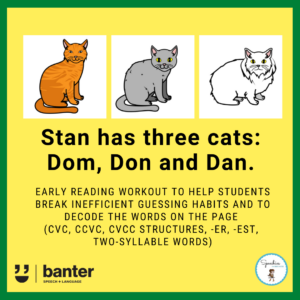
- Early reading workout: Stan has three cats – Dom, Don and Dan (CVC, CCVC and CVCC words)
- High frequency digraph sentences featuring sh, ck, th, wh and qu words
- Early sound blending practice 4: CCVC words – starting with a continuant

Related products
-
-
-
(R703) Think, Then Write Workbook 4: Paragraph Writing Foundations
$65.00 including GST -

 (R413) The Scatter-Slayer Adventures: Book 1 – Don’t Stay! Be Afraid!
 (R209) CCVC Words in Sentences: Is Stan a Brat?
 Speech Therapy by Telehealth (Video Conferencing): Parent Guidelines
 (R701) NAPLAN: Year 3 - Essential Language Convention Skills for NAPLAN (Nouns and Proper Nouns)
 (R214) CVCC Words in Sentences: Wendy has zest!
