


(R216) Early sound blending practice 6: CCVCC words – starting with a continuant
$5.99 including GST
Now that the student has learned to decode and encode simple CVC, CCVC and CVCC words composed on the basic code, we step up to working with consonant-consonant-vowel-consonant-consonant (CCVCC) word structures composed of high frequency letter-sound links.
Why blending? Learning to decode letters into speech sounds, and then to blend the speech sounds together to form words is a fundamental reading skill for all students in their first year of schooling.
Why read and write the words? Early encoding (writing) practice helps consolidate early decoding (reading) skills (and vice versa).
Description
Why blending? Learning to decode letters into speech sounds, and then to blend the speech sounds together to form words is a fundamental reading skill for all students in their first year of schooling.
Why the basic code? Now that the student has learned to decode and encode simple CVC, CCVC and CVCC words composed on the basic code, we step up to working with consonant-consonant-vowel-consonant-consonant (CCVCC) word structures composed of high frequency letter-sound links.
Why start the words with continuants? A continuant is a consonant which is sounded with the vocal tract partly closed, which allows the breath to pass through and for the speech sound to be stretched or prolonged (e.g. /f, l, m, n, r, s/ and /v/). They’re easier to blend for beginners than words that start with short ‘stops’ like <b>, <d> or <g>.
Why read and write the words? Early encoding (writing) practice helps consolidate early decoding (reading) skills (and vice versa).
This no-prep resource can be downloaded in PDF and Google Slides formats.
Related resources:
- Early sound blending practice 1: CVC words with short a and e vowels
- Early sound blending practice 2: CVC words with short i and o vowels
- Early sound blending practice 3: CVC words with short u vowel
- Early sound blending practice 4: CCVC words – starting with a continuant
- Early sound blending practice 5: CVCC words – starting with a continuant
- The b/d letter-sounds sorter (with CVC words, sentence and story workout)
- CCVC Words in Sentences: Is Stan a brat?
- CVCC Words in Sentences: Wendy has zest!
- Early Reading Workout – Stan has three cats: Dom, Don and Dan (CVC, CVCC, CCVC)
- Split digraph minimal pair sentences
- Polysyllabic words in sentences
For free, decodable stories focusing on the basic code, check out: Is your Kindy kid really reading? Find out with our 7 free mini stories.

Related products
-
(R703) Think, Then Write Workbook 4: Paragraph Writing Foundations
$65.00 including GST -
-
-

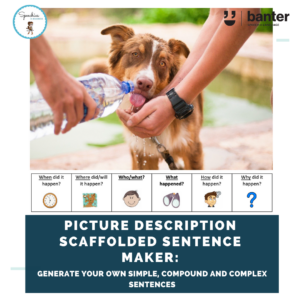 (L236) Picture Description Scaffolded Sentence Maker: generate your own simple, compound and complex sentences
 (L310) Blanks 3: How are things the same?
 (S114) Stuttering Superhero Cards
 (L322) Theory of Mind: We are all different, and like different things. That's OK!
 (L405) Blanks 4: Language Comprehension Booster: Why will...?
 (S115) Stuttering and fluency wellness snapshot for school-aged children who stutter
 (F519) Advanced Speech Sound Exercises: Discourse Level Exercises - Alveolar Speech Sounds
 (L242) Conjunctions - When (Auditory Bombardment)
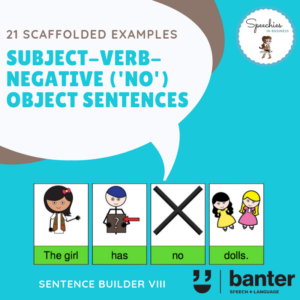 (L123) Subject Verb Negative ("No") Object (SVNegO) Sentences
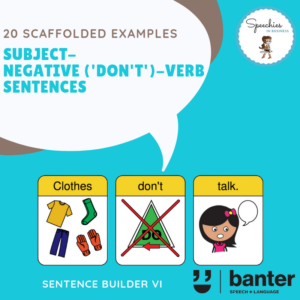 (L126) Subject-Negative ('Don't')-Verb (SNegV Don't) Sentence Builders
 No-Prep Basic Reinforcement Pack I
 (L119) Subject-Verb-Object (SVO) Sentence Builders
 (S109) Lidcombe Program Starter Series: Resources for Highly Structured Practice: Name that Dinosaur (or other Prehistoric Reptile)!
 (R209) CCVC Words in Sentences: Is Stan a Brat?
