


(L522) Exam and essay verbs you need to know in high school: “Describe”
$6.99 including GST
This 22-page no-prep slide-pack is composed of 10 activities, all focused on the word “describe”.
In this pack, we have addressed each of these elements to focus on the word “describe”. Describe is one of the more common academic verbs used in exams and essays. It is also a fundamental verbal reasoning skill required for higher study, work, community activities, and in personal relationships.
Description
Research tells us that we should:
-
teach young high-schoolers some specific words explicitly; and
-
choose words that are:
-
cross-curriculum words: words used in high school across multiple subjects. (Cross-curriculum words are also known as “academic words” or “tier 2 words”. You can read more about these words, find out why they are so useful, and access longer words lists and other free resources here);
-
highly functional: words that can used in all sorts of places, with all sorts of people in the “real world”; and
-
verbs: these are harder to learn than nouns, especially for children with language, learning or reading difficulties (e.g. Nash & Snowling, 2006).
-
To date, vocabulary interventions show that you can teach kids new words. But choosing the right words is really important because:
-
it takes lots of work for a child to learn a new word, especially if the child has language, learning or reading difficulties; and
-
learning a word doesn’t seem to automatically help a child learn other words (e.g. Snow et al., 2009).
When teaching high schoolers new words, the evidence tells us we should go for depth of word knowledge, rather than going for lots words. Research also tells us that we should teach high school students new words:
-
intensively: at least an hour a week, with home exercises between sessions;
-
one word at a time;
-
by defining the word explicitly;
-
using lots of repetition, in lots of different contexts;
-
ideally, in small groups (3-5 children) so they can work together and discuss the words based on their real world experiences;
-
by giving them lots of opportunities to use the word in different ways;
-
focus on different aspects of the word including the:
-
meaning of the word;
-
speech sounds and syllables that make up the word;
-
grammatical role of the word;
-
morphology of the word, including the word origin; and
-
spelling of the word;
-
-
using activities the students like to increase motivation and engagement (e.g. by consulting “experts” on YouTube or Reddit);
-
using gestures (there is some evidence that miming an action while saying the word can help younger children to learn verbs e.g. Riches et al., 2005); and
-
giving students personal challenges to use and act out the word at home or out and about.
What’s in the pack?
The 22-page no-prep slide-pack is composed of 10 activities, all focused on the word “describe”. Consistent with the research, in these exercises, we:
-
read a short passage so students can see and hear the word in action;
-
define the word so students know what it means;
-
look closely at the word and its variants, as well as the word origin so students understand the word better;
-
listen to recorded sentences containing the word in everyday situations so students can hear how it is used;
-
teach practical strategies to answer questions containing the word with real world examples;
-
help the students answer “describe” questions based on their general knowledge of the world; and
-
look and talk about some real examples of how the the word has been used in different subjects in recent senior exam questions.
The slides can be used one-to-one with a student, with small groups, or in whole class teaching. They are suitable for children aged 12-16, and older children with language, reading or other learning disorders. They are also suitable for high school children who are learning English as an additional language.
Principal source and more resources:
Spencer, S., Clegg, J., Lowe, H., Stackhouse, J. (2017). Increasing adolescents’ depth of understanding of cross-curriculum words: an intervention study. International Journal or Language and Communication Disorders, 52(5), 652-668. Abstract link: http://onlinelibrary.wiley.com/doi/10.1111/1460-6984.12309/abstract
Be sure to check out the wonderful research of other resources created by Dr Sarah Spencer and colleagues, with free session plans for the following academic verbs:
-
Interpret
-
Evaluate
-
Exclude
-
Sustain
-
Discriminate
-
Infer
-
Contribute
-
Generate
-
Summarise
-
Consult
https://adolescentvocabulary.wordpress.com/why-support-teenagers-to-learn-new-words/. (Note that we have no business or other relationship with Dr Spencer’s work, other than being big fans of it.)
Related articles:
- Worried about the HSC? 8 practical (and free) things you can do this week to get ready
- 10 great words to teach young high-schoolers (and why) – with brilliant free resources!
- For reading, school and life success, which words should we teach our kids? How should we do it?

Related products
-
-
(L126) Subject-Negative (‘Don’t’)-Verb (SNegV Don’t) Sentence Builders
$5.99 including GST -
-
 (L273) Sentence builders: "Although" as a Subordinating Conjunction
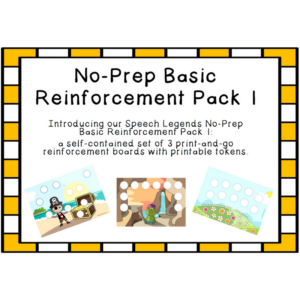 No-Prep Basic Reinforcement Pack I
 (F505) The Theatre Folk: A Dental-Alveolar Story
 (L106) Pronouns: He/She - Subjective Pronouns No-Prep Workout Pack
 (F513): Chief Shoshone and A Palatal Thriller: Palatal-Palatal Stories
 (R401) Extended Code: A Gloomy Day In My Room For Yet More Zoom Doom! A Silly 'oo' Sentence Story Workout
 (L143) Pronouns: No Prep Subjective Pronoun (I, you, he, she, they) + has/have Pack
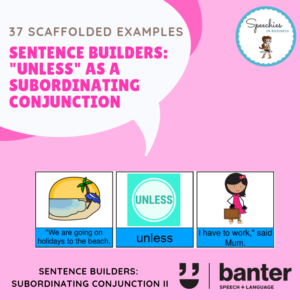 (L246) Sentence builders: "Unless" as a Subordinating Conjunction
 (F501) The Wolf Matthew, the Beaver, and the Moth: A Bilabial-Dental Story
 (R305) Decoding Polysyllabic Words in Sentences: My Mother Is Impressive
 (S115) Stuttering and fluency wellness snapshot for school-aged children who stutter
 (L235) Complex sentence picture description task: 'if' and 'while' sentences
 (S125) Speech Fluency & Naturalness Practice-Readings for Students and Adults who Stutter: Volume 6 (Famous Essays)
 Carrier Phrases for Speech, Language, Stuttering and Voice Therapy
 (S118) Picture Description Resources for Stuttering Therapy (Volume 2)
 (S122) Speech Fluency & Naturalness Practice-Readings for Students who Stutter: Volume 3 (Poems)
 (S107) Lidcombe Program Starter Series: Resources for Highly Structured Practice: Say What I Say
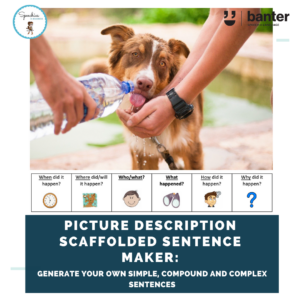 (L236) Picture Description Scaffolded Sentence Maker: generate your own simple, compound and complex sentences
 (R213) CVC and CCVC Words: Voiceless stops (/p, t, k/) vs voiced stops (/b, d, g/)
 (C304) Complexity Approach: True Clusters with a Sonority Difference of 4 (/sw, bl, gl, br, dr, gr/)
 (F519) Advanced Speech Sound Exercises: Discourse Level Exercises - Alveolar Speech Sounds
 (E411) Slushy /s/ Zapper: A Lateral Lisp Treatment Resource
 (E414) A /k/-initial aspiration trick story (for velar fronting and /k/ articulation)
 (F516): Roger Saves the Day? A Palatal Mixed Movement Story
 (F514): Roger at the Ranch: A Palatal-Palatal Story
 (L242) Conjunctions - When (Auditory Bombardment)
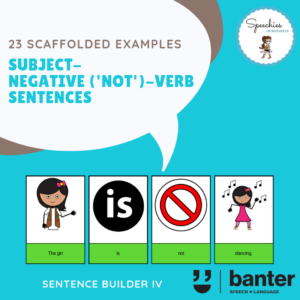 (L124) Subject-Negative ('not')-Verb (SNegV) Sentence Builders
