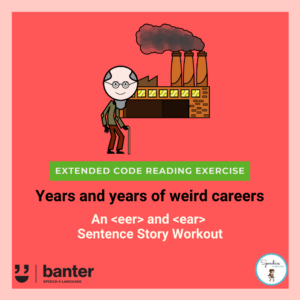


(R412) Extended Code: Years and years of weird careers: An ‘eer’ and ‘ear’ Sentence Story Workout
$4.99 including GST
In this reading exercise, students read many words containing <eer> and <ear> (e.g. “cheer”, “dear”). For efficiency and engagement, we find it best to work on extended code targets like <eer> and <ear> while also working on reading fluency (accuracy, speed and expression) with sentences and short passages.
This reading workout is about a mysterious stranger struggling to survive in a tough world. He seems friendly. But, there’s something not quite right here. Should we be worried? Let’s find out!
This no-prep exercise can be used for:
- decoding practice; or
- word or sentence level written dictation (encoding) practice.
Description
Years and years of weird careers: An <eer> and <ear> Sentence Story Workout
After students have learned to decode:
- one-syllable and polysyllabic words composed of the basic code; and
- words like “lake”, “Steve”, “like”, “woke” and “mute” containing split digraphs,
it’s time to teach them how to decode words containing the extended code.
Extended code: Where to start?
Written English is alphabetic, but there are 461 possible letter-sound mappings in English, and more than two billion words. Although these facts can be intimidating to teachers and others who are working with students who are learning to read, research shows that, with knowledge of just 64 high frequency graphemes, and around 100 high frequency words, students can read around 90% of the words in texts that they will typically encounter:
In this reading exercise, students read many words containing <eer> and <ear> (e.g. “cheer”, “dear”). For efficiency and engagement, we find it best to work on extended code targets like <eer> and <ear> while also working on reading fluency (accuracy, speed and expression) with sentences and short passages.
This reading workout is about a mysterious stranger struggling to survive in a tough world. He seems friendly. But, there’s something not quite right here. Should we be worried? Let’s find out!
This no-prep exercise can be used for:
- decoding practice; or
- word or sentence level written dictation (encoding) practice.
While illustrated, we have designed the sentences to discourage guessing from context or pictures, and to instead promote the phonological awareness skills most correlated with reading outcomes, namely letter-sound links, blending and segmenting skills. We’ve also worked hard to make the sentences motivating for students to read – including older students with dyslexia and other learning disorders.
We hope your students find this reading exercise useful and engaging as you work with them to learn and master high frequency extended code digraphs like <eer> and <ear>.
Related resources:
- I really, really need a Jeep! A silly <ee> and <ea> sentence story workout
- A Gloomy Day In My Room For Yet More Zoom Doom! A Silly <oo> Sentence Workout
- My Brain Plays Every Day in Winter Bay: An <ay>, <ai> Sentence Story Workout
- Should we go on Joe’s boat? An <oa>, <ow> and <oe> Sentence Story Workout
- Why I like my night shift. A <y> and <igh> Sentence Story Workout
- When the crew visited New Zealand with Sue needing some bruise-curing Kiwi fruit: An <ew>, <ui> & <ue> Sentence Story
- Is Paula appalling or just boring? An <au>, <or>, <aw>, <all> Sentence-Story Workout
- When Sir Bertie, son of an Earl, went to work for a cursed firm: An <er>, <ir>, <ur>, <wor>, <ear> Sentence Story Workout
- Why I enjoy spoiling my boys: An <oy> and <oi> Sentence Story Workout
- Where can Claire share her flair? An <air>, <are> and <ere> Sentence Story Workout
Click here for a free copy of the first instalment in The Scatter-Slayer Adventures series: Don’t Stay! Be Afraid (<ai> and <ay>).
This is the first of our decodable digital ‘select-your sequel’ adventure series, focusing on the extended code and increasing reading fluency. Where you decide what happens next.
Also available:
- Attack of the Eel Beast (<ee> and <ea>)
- The Zoo Druid (<oo> (moon), <oo> (took) and <u_e>)
- The Shark Arcade (<ar> and <a>)
- The Glowing Toad (<oa>, <ow> and <oe>)
- The Blue-Bruised Newt (<ue>, <ui>, and <ew>)
- The Nervous Furnace Workers’ Well-Earned Liberation (<er>, <ur>, <ir>, and <ear>)
- The Awesome Australian Gore-Boar (<aw>, <au>, <or>, <oar> and <ore>)
- The Spoiled Boy (<oi> and <oy>)
- The Scarecrow and Bear Fair in the Land of Nowhere (<air> and <are>)


 (L273) Sentence builders: "Although" as a Subordinating Conjunction
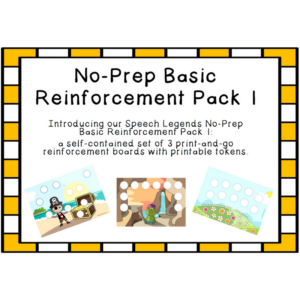 No-Prep Basic Reinforcement Pack I
 (F505) The Theatre Folk: A Dental-Alveolar Story
 (L106) Pronouns: He/She - Subjective Pronouns No-Prep Workout Pack
 (F513): Chief Shoshone and A Palatal Thriller: Palatal-Palatal Stories
 (R401) Extended Code: A Gloomy Day In My Room For Yet More Zoom Doom! A Silly 'oo' Sentence Story Workout
 (L143) Pronouns: No Prep Subjective Pronoun (I, you, he, she, they) + has/have Pack
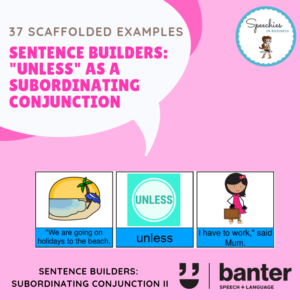 (L246) Sentence builders: "Unless" as a Subordinating Conjunction
 (F501) The Wolf Matthew, the Beaver, and the Moth: A Bilabial-Dental Story
 (S115) Stuttering and fluency wellness snapshot for school-aged children who stutter
 (L235) Complex sentence picture description task: 'if' and 'while' sentences
 (S125) Speech Fluency & Naturalness Practice-Readings for Students and Adults who Stutter: Volume 6 (Famous Essays)
 Carrier Phrases for Speech, Language, Stuttering and Voice Therapy
 (S118) Picture Description Resources for Stuttering Therapy (Volume 2)
 (S122) Speech Fluency & Naturalness Practice-Readings for Students who Stutter: Volume 3 (Poems)
 (S107) Lidcombe Program Starter Series: Resources for Highly Structured Practice: Say What I Say
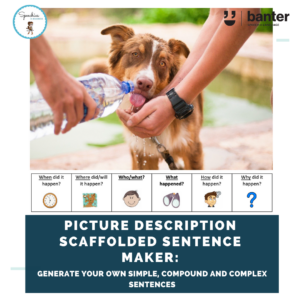 (L236) Picture Description Scaffolded Sentence Maker: generate your own simple, compound and complex sentences
 (R213) CVC and CCVC Words: Voiceless stops (/p, t, k/) vs voiced stops (/b, d, g/)
 (C304) Complexity Approach: True Clusters with a Sonority Difference of 4 (/sw, bl, gl, br, dr, gr/)
 (F519) Advanced Speech Sound Exercises: Discourse Level Exercises - Alveolar Speech Sounds
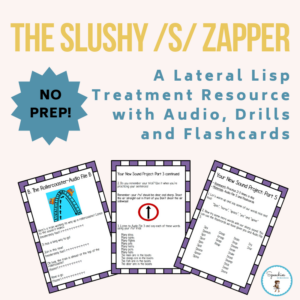 (E411) Slushy /s/ Zapper: A Lateral Lisp Treatment Resource
 (E414) A /k/-initial aspiration trick story (for velar fronting and /k/ articulation)
 (F516): Roger Saves the Day? A Palatal Mixed Movement Story
 (F514): Roger at the Ranch: A Palatal-Palatal Story
 (L242) Conjunctions - When (Auditory Bombardment)
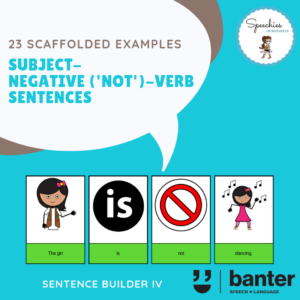 (L124) Subject-Negative ('not')-Verb (SNegV) Sentence Builders
 (R702) Essential Language Convention Skills (Capital Letters and Full Stops)
 (L256) Conjunction Board Game
 (R414) The Zoo Druid
 (R304) Decoding Polysyllabic Words in Sentences: My Dad Does Several Silly Things
 (L276) Complex Sentences (Subordinating Conjunctions) Bundle
 (L263) Low-Prep Possessive ’s Story-Bootcamp Practice Pack
 (R509) Think, Then Write Workbook 2: FANBOYS Compound Sentences
 (R701) NAPLAN: Year 3 - Essential Language Convention Skills for NAPLAN (Nouns and Proper Nouns)
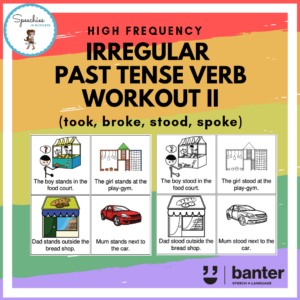 (L133) Verbs: Irregular Past Tense Verb Workout 2 (took, broke, stood, spoke)
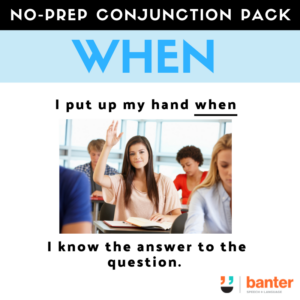 (L241) No Prep, Evidence-Based Conjunction Pack: 'When'
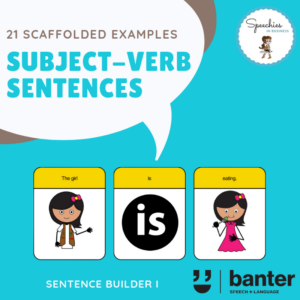 (L109) Subject-Verb (SV) Sentence Builders
 (L111) Subject-Verb (-ing) (Auditory bombardment)
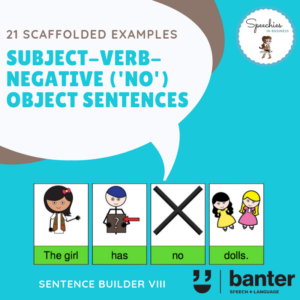 (L123) Subject Verb Negative ("No") Object (SVNegO) Sentences
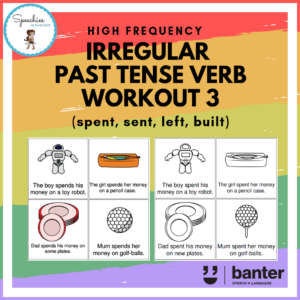 (L134) Verbs: Irregular Past Tense Verb Workout 3 (spent, sent, left, built)
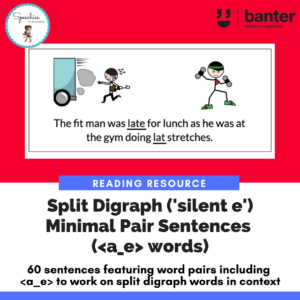 (R308) Reading Resource: Split Digraph ('silent e') Minimal Pair Sentences: a_e words
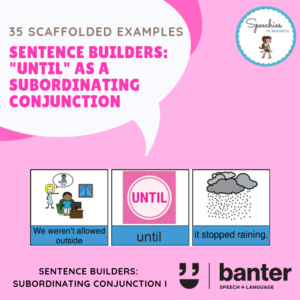 (L250) Sentence builders: "Until" as a Subordinating Conjunction
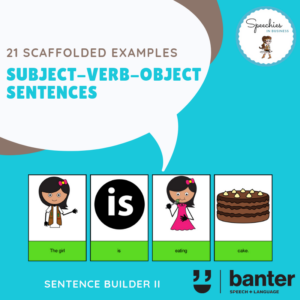 (L119) Subject-Verb-Object (SVO) Sentence Builders
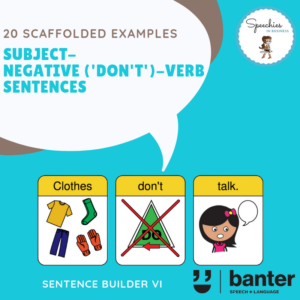 (L126) Subject-Negative ('Don't')-Verb (SNegV Don't) Sentence Builders
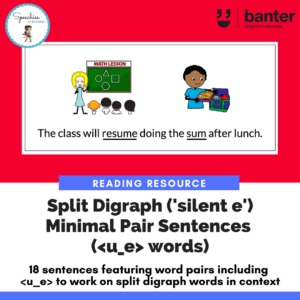 (R311) Reading Resource: Split Digraph ('silent e') Minimal Pair Sentences: u_e words
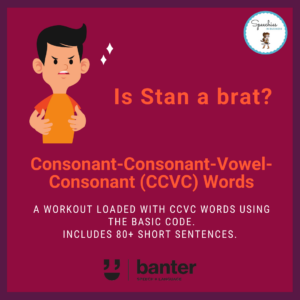 (R209) CCVC Words in Sentences: Is Stan a Brat?
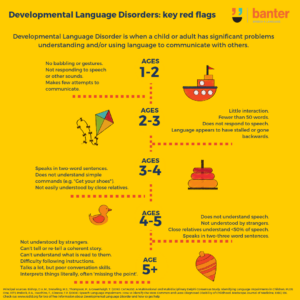 Developmental Language Disorder: Key Red Flags
 Speech Therapy by Telehealth (Video Conferencing): Parent Guidelines
 (L129) Subject-Verb-Complement (Auditory Bombardment)