


(L151) “Is” and “Are” (Copula Verb Forms) Sentence Workout
$5.99 including GST
Many people – including lots of people learning English as a second language and people with language disorders – have difficulties using words like “is” or “are” in sentences containing main verbs.
This 29-page no-prep pack with 26 pairs of sentences is designed to provide people in this situation with focused, scaffolded practice of the form, using subjects that take the regular plural morpheme ‘s’ at the end. (Typically developing kids start to use regular plurals around 24-30 months of age). This pack uses both pictures and orthography, making it suitable for children or adults.
Description
Before the age of 3 years, typically developing children start to make sentences using different forms of the copula verb “to be” (e.g. “is” or “are” ) to ‘help out’ main verbs. An example is “The girl is running. The girls are jumping.”. Many people – including lots of people learning English as a second language and people with language disorders – have difficulties using words like “is” or “are” in sentences containing main verbs.
This 29-page no-prep pack with 26 pairs of sentences is designed to provide people in this situation with focused, scaffolded practice of the form, using subjects that take the regular plural morpheme ‘s’ at the end. (Typically developing kids start to use regular plurals around 24-30 months of age). This pack uses both pictures and orthography, making it suitable for children or adults.

 (S130) The Oakville Program for young school-age children who stutter: mini-client handbook and scripted modules
 (L267) Can I...? Questions (Auditory bombardment)
 (R807) Think Then Write Workbook 6: Narrative Writing Foundations
 (L229) Conjunctions - Because (Auditory bombardment)
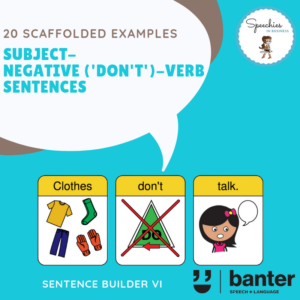 (L126) Subject-Negative ('Don't')-Verb (SNegV Don't) Sentence Builders
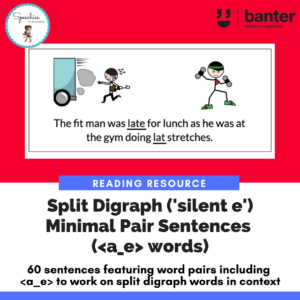 (R308) Reading Resource: Split Digraph ('silent e') Minimal Pair Sentences: a_e words
 (R806) Think Then Write Workbook 5: Multi-Paragraph Information Report Writing Foundations
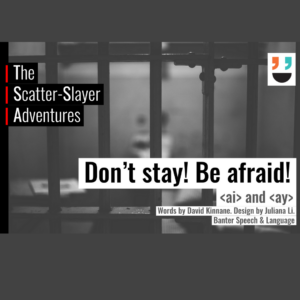 (R413) The Scatter-Slayer Adventures: Book 1 – Don’t Stay! Be Afraid!
 (L242) Conjunctions - When (Auditory Bombardment)
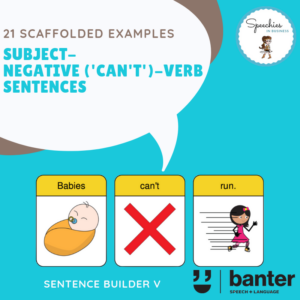 (L125) Subject-Negative ('Can't')-Verb (SNegV Can't) Sentences
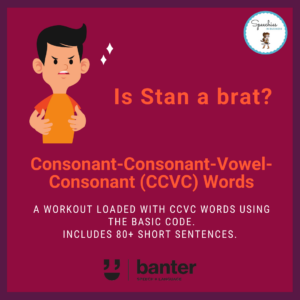 (R209) CCVC Words in Sentences: Is Stan a Brat?
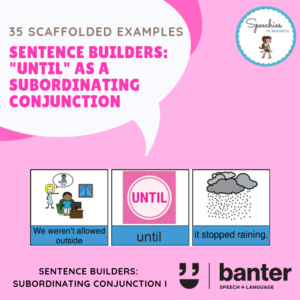 (L250) Sentence builders: "Until" as a Subordinating Conjunction
 Word Learner
 (R415) Attack of the Eel Beast
 (R214) CVCC Words in Sentences: Wendy has zest!
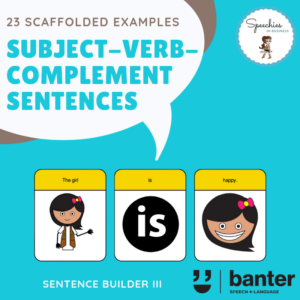 (L128) Subject-Verb-Complement (SVC) Sentence Builders
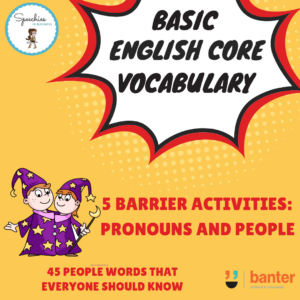 (L144) Barrier Activities - Basic English Core Vocabulary: Pronouns and People
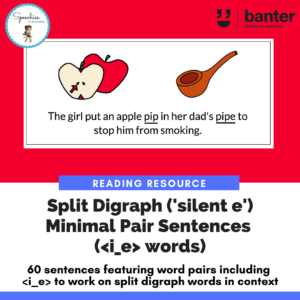 (R309) Reading Resource: Split Digraph ('silent e') Minimal Pair Sentences: i_e words
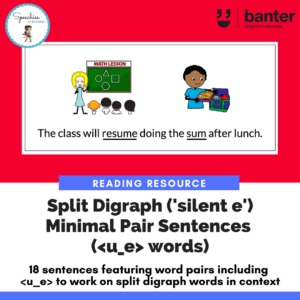 (R311) Reading Resource: Split Digraph ('silent e') Minimal Pair Sentences: u_e words
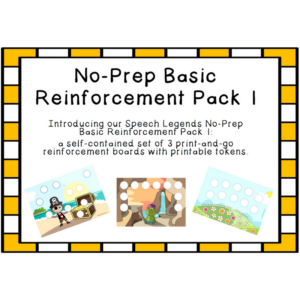 No-Prep Basic Reinforcement Pack I
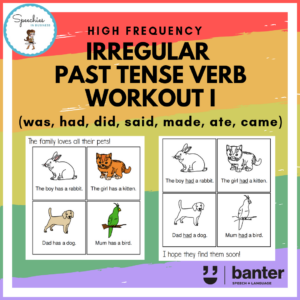 (L132) Verbs: Irregular past tense verb workout 1 (was, had, did, said, made, ate, came)
 (R614) High Frequency Suffixes for Reading and Writing: "-our" or "-or"
 (R703) Think, Then Write Workbook 4: Paragraph Writing Foundations
 (S122) Speech Fluency & Naturalness Practice-Readings for Students who Stutter: Volume 3 (Poems)
 (L270) Verbs: Future Tense Verbs: Auxiliary Verb "going to" (e.g. "The girl is going to sing")
 (R421) The Nervous Furnace Workers' Well-Earned Liberation
 (L135) Verbs: Irregular Past Tense Verb Workout 4 (knew, drew, grew, threw)
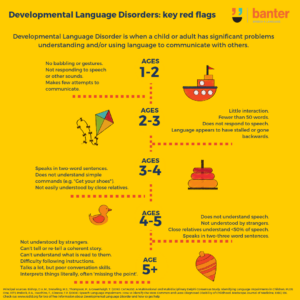 Developmental Language Disorder: Key Red Flags
 (L306) "What is it"? Foundations: Objects in Familiar Environments
 Speech Therapy by Telehealth (Video Conferencing): Parent Guidelines
 (R305) Decoding Polysyllabic Words in Sentences: My Mother Is Impressive
 (R613) High Frequency Suffixes for Reading and Writing: "-ship"
 (R810) Book Hacker: How to read a book to understand it quickly
 (R701) NAPLAN: Year 3 - Essential Language Convention Skills for NAPLAN (Nouns and Proper Nouns)
 (R216) Early sound blending practice 6: CCVCC words - starting with a continuant
 (R306) Decoding Polysyllabic Words in Sentences: My Grandmother Is a Touch Unusual
