


(L278) Concepts in action: Empty (a level 2 quantity concept)
$5.99 including GST
10 GIF-based video models of simple, compound and complex sentences featuring early language concepts in context. The videos feature the Banter Boys and friends demonstrating foundational language concepts in a variety of ways. In this no-prep resource we focus on the concept of ’empty’.
We also include tips, and hands-on activities for exploring concepts in the ‘real world’ with your child.
Description
10 GIF-based video models of simple, compound and complex sentences featuring early language concepts in context. The videos feature the Banter Boys and friends demonstrating foundational language concepts in a variety of ways. In this no-prep resource we focus on the concept of ’empty’.
Way back in 1985, Ann Locke* developed a very useful framework to teach basic language concepts to young children, including concepts of size, space, texture, sound, shape, movement, quantity, time, and qualities.
As with verbs, language concepts can be difficult for some children to learn because they are often abstract and intangible.
This resource applies research showing we should teach basic language concepts:
-
- one at a time (not in pairs of opposites);
- in a developmentally appropriate order;
- using real situations, to help children to see and to experience the concepts in action; and
- in a variety of contexts so children can learn about the different ways these concepts are used in different situations (places and times).
As an example of slow movement in action:
-
- Subject Verb Complement: The cans are empty.
- Subject Verb Object: The wind blew the empty cans over.
- Question: How do you know that the cans are empty?
- Complex Sentence: If the were not empty, they wouldn’t blow away so easily!
We also include tips, and hands-on activities for exploring concepts in the ‘real world’ with your child.
To play the GIFs, copy the slides onto your Google Drive.
Related resources:
* Locke, A. (1985) Living Language, NFER-Nelson

 (S129) Speech Fluency & Naturalness Practice for Students and Adults who Stutter: Volume 8 (Short Stories)
 (L511) Listen then Speak Spooky Edition: an oral language workout for students in Years 2-5
 (S125) Speech Fluency & Naturalness Practice-Readings for Students and Adults who Stutter: Volume 6 (Famous Essays)
 (L267) Can I...? Questions (Auditory bombardment)
 (L503) Listen then Speak 3: an oral language workout for students in Years 2-5
 (L123) Subject Verb Negative ("No") Object (SVNegO) Sentences
 (L507) Listen then Speak 7: an oral language workout for students in Years 2-5
 (S115) Stuttering and fluency wellness snapshot for school-aged children who stutter
 Word Learner
 (S120) Speech Fluency & Naturalness Practice-Readings for Students who Stutter: Volume 1 (Nonsense Verses)
 (R201) Early sound blending practice 1: CVC words with short a and e vowels
 (L161) Concepts in action: Slow (a level 1 movement concept)
 (L403) Theory of Mind: How does she think he is feeling? A Second-Order Theory of Mind Picture Resource
 (L509) Listen then Speak 9: an oral language workout for students in Years 2-5
 (L326) Christmas Season Language Comprehension Booster
 (L252) Sentence Maker: “Until” and “Unless”
 (L159) Concepts in action: Happy (a level 1 feelings concept)
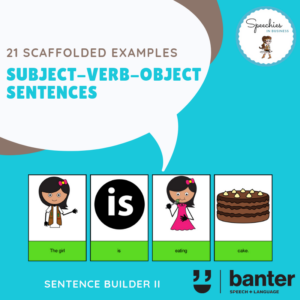 (L119) Subject-Verb-Object (SVO) Sentence Builders
 (L129) Subject-Verb-Complement (Auditory Bombardment)
 (R602) High Frequency Prefixes for Reading and Writing: "Re-"
 (L414) Theory of Mind and Blank's Level 4 Questions Picture Resource
 (L306) "What is it"? Foundations: Objects in Familiar Environments
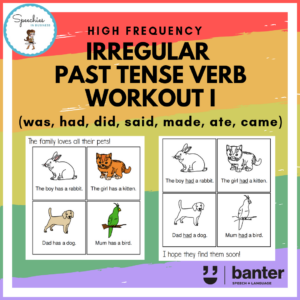 (L132) Verbs: Irregular past tense verb workout 1 (was, had, did, said, made, ate, came)
 (S118) Picture Description Resources for Stuttering Therapy (Volume 2)
 (L508) Listen then Speak 8: an oral language workout for students in Years 2-5
 (R515) Think, Then Write: Sentence Writing Bootcamp
 (R604) High Frequency Prefixes for Reading and Writing: "De-"
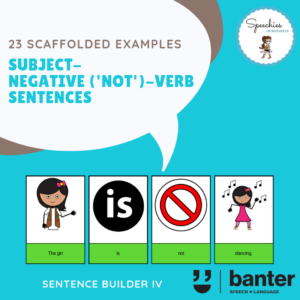 (L124) Subject-Negative ('not')-Verb (SNegV) Sentence Builders
 (L504) Listen then Speak 4: an oral language workout for students in Years 2-5
 (L111) Subject-Verb (-ing) (Auditory bombardment)

Reviews
There are no reviews yet.