


(L331) Relative Clause Mega Workout (that, who)
$8.00 including GST
In this resource, we provide structured practice to understand, repeat, complete and then formulate sentences with relative clauses starting with “that” (for objects, plants and animals) and “who” (for people).
This 76-page resource features photographs and words and shows relative clauses in the context of complex sentences.
It is suitable for use with children and adults, and for face-to-face and distance learning sessions.
Description
Structured practice following directions, repeating, completing, and then formulating sentences containing the relative clauses ‘that’ or ‘who’.
Between the ages of 4-5 years of age, typically developing children start to form sentences containing relative clauses (Barako Arndt & Schuele (2013)).
A relative clause is a subordinate clause that specifies or gives information about a person or a thing. They come after nouns or pronouns; and often begin with a relative pronoun such as “who”, “that”, or “which”. They can help specify or describe what you are talking about in enough detail for others to understand.
For example:
-
- The librarian who works on Wednesdays caught the bus to work.
- The snake that had yellow spots and red stripes was highly venomous.
- The lawnmower, which is in the garage, needs a service.
Many children need additional help to understand and use sentences containing relative clauses – including some children with developmental language and learning disorders, and some people learning English as a second language. This resource is designed to give children lots of practice with relative clauses in sentences.
In this resource, we provide structured practice to understand, repeat, complete and then formulate sentences with relative clauses starting with “that” (for objects, plants and animals) and “who” (for people).
This resource features photographs and words and shows relative clauses in the context of complex sentences. It is suitable for use with children and adults, and for face-to-face and distance learning sessions.

Related products
-
-
-

-
(L145) Subject-Verb-Object-Adverbial Phrase (SVOA) Sentence Builders
$5.99 including GST
 (L317) Verbs: Regular Past Tense Verbs 4: when “ed" is pronounced as /t/, /d/ and /əd/
 (L281) Concepts in action: Many (a level 2 quantity concept)
 (R210) Early sound blending practice 5: CVCC words - starting with a continuant
 (S117) Picture Description Resources for Stuttering Therapy (Volume 1)
 (L277) School Readiness Oral Language and Pre-Literacy Essentials
 (L323) Book: Dog Man by Dav Pilkey: Language Companion
 (L278) Concepts in action: Empty (a level 2 quantity concept)
 Australian SLP Private Practice Business Planning Kit including One-Page Business Plan
 (R810) Book Hacker: How to read a book to understand it quickly
 (R606) High Frequency Prefixes for Reading and Writing: "Mis-"
 (L330) Concepts in action: Frightened (a level 3 feelings concept)
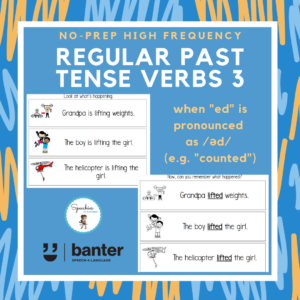 (L316) Verbs: Regular Past Tense Verbs 3: when "ed" is pronounced as /əd/
 (L136) Verbs: Irregular Past Tense Verb Workout 5 (slept, went, meant)
 (L122) Plurals: Practising Regular Plural Nouns
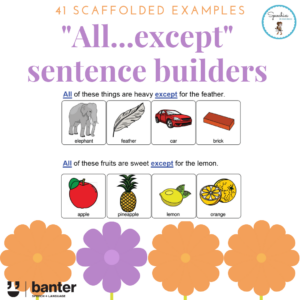 (L255) All...except Sentence Builders
 (L327) Relative Clause Sentence Workout Bundle: Who, That, Which
 (L318) "He's" and "She's" - Contractible Copula and Auxiliary Verbs Mega Workout
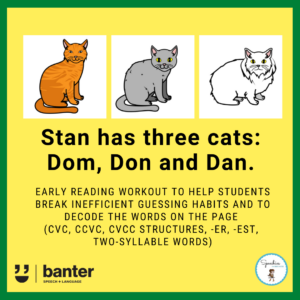 (R215) Early Reading Workout - Stan has three cats: Dom, Don and Dan (CVC, CVCC, CCVC)
 (L129) Subject-Verb-Complement (Auditory Bombardment)

Reviews
There are no reviews yet.