


(L205) Blanks 2: Tell me something that is a/an….?
$5.99 including GST
In this 25-page no-prep pack, we target a Blank’s Level 2 comprehension task. Specifically, we ask students to name members of common categories. This work can also help children to classify things and to build their semantic knowledge by helping them classify objects by category or groups.
Description
Some researchers think that up to 15% of young school kids don’t have the language comprehension skills to cope fully with the demands of school (Hart & Fielding-Barnsley, 2009). Many of these kids struggle – some for their whole lives. For most kids, school and home life plays a big role in helping to understand and use language (Morgan & Goldstein, 2004; Nation, 2005). So what can we do to improve students’ understanding of language?
Well, it helps to have a plan. And good plans are based on tried and tested frameworks. For language comprehension, one of the most influential frameworks was developed by Dr Marion Blank, a developmental psychologist. Dr Blank proposed four levels of abstraction, from least to most abstract:
Level 1: Directly supplied information (Matching perception)
Level 2: Classification
Level 3: Reorganisation
Level 4: Abstraction and Inferences
Many kids start school with an ability to complete Level 1 and 2 tasks. But some don’t; and many students with limited language skills really struggle with verbs of function – naming the action performed by a given part, which can hamper oral language development and reading comprehension skills.
In this 25-page no-prep pack, we target a Blank’s Level 2 comprehension task. Specifically, we ask students to name members of common categories. This work can also help children to classify things and to build their semantic knowledge by helping them classify objects by category or groups.
This exercise can be completed in any language. To make the exercise more challenging, ask the student to name two or three more things in the group.


 (R409) Extended Code: When Sir Bertie, son of an Earl, went to work for a cursed firm: An 'er', 'ir', 'ur', 'wor', 'ear' Sentence Story Workout
 (R412) Extended Code: Years and years of weird careers: An 'eer' and 'ear' Sentence Story Workout
 (L235) Complex sentence picture description task: 'if' and 'while' sentences
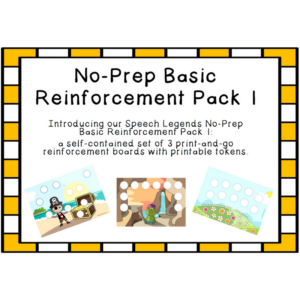 No-Prep Basic Reinforcement Pack I
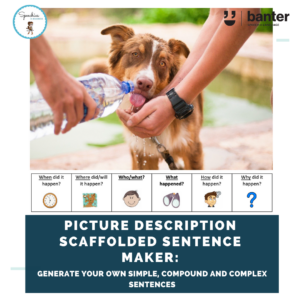 (L236) Picture Description Scaffolded Sentence Maker: generate your own simple, compound and complex sentences
 (C303) Complexity Approach: True Clusters with a Sonority Difference of 3 (/fl, sl, fr, shr and thr/)
 (C301) Complexity Approach: 3-sound clusters (/spl, str, skw, skr and spr/)
 (E414) A /k/-initial aspiration trick story (for velar fronting and /k/ articulation)
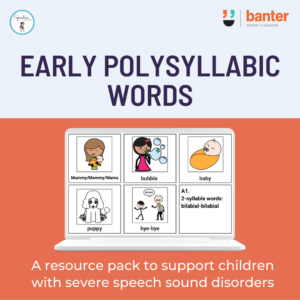 (B210) Early polysyllabic words: a resource pack to support children with severe speech sound disorders
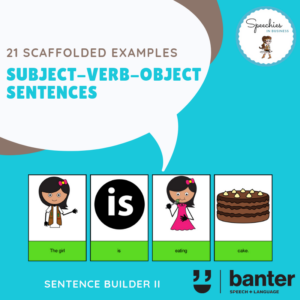 (L119) Subject-Verb-Object (SVO) Sentence Builders
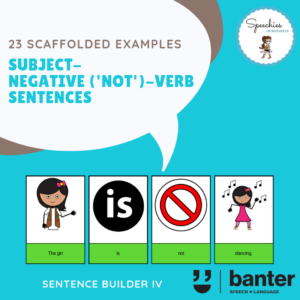 (L124) Subject-Negative ('not')-Verb (SNegV) Sentence Builders
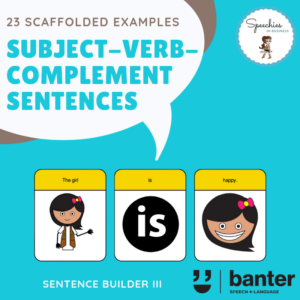 (L128) Subject-Verb-Complement (SVC) Sentence Builders
 (F501) The Wolf Matthew, the Beaver, and the Moth: A Bilabial-Dental Story
 Complex Cluster Targets for use with a Cycles Approach, Complexity Approach or Contrastive Approach
 (S118) Picture Description Resources for Stuttering Therapy (Volume 2)
 (A100) Sound Cards
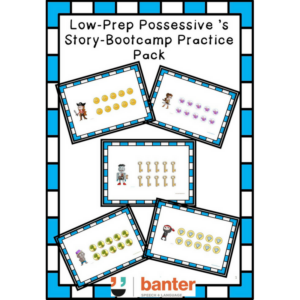 (L263) Low-Prep Possessive ’s Story-Bootcamp Practice Pack
 (L111) Subject-Verb (-ing) (Auditory bombardment)
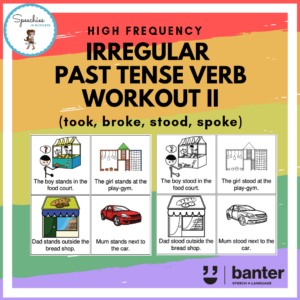 (L133) Verbs: Irregular Past Tense Verb Workout 2 (took, broke, stood, spoke)
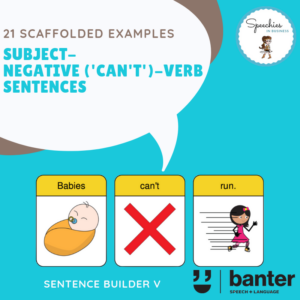 (L125) Subject-Negative ('Can't')-Verb (SNegV Can't) Sentences
 (C302) Complexity Approach: True Clusters with a Sonority Difference of 2 (/sm/ and /sn/)
 (F519) Advanced Speech Sound Exercises: Discourse Level Exercises - Alveolar Speech Sounds
 (R213) CVC and CCVC Words: Voiceless stops (/p, t, k/) vs voiced stops (/b, d, g/)
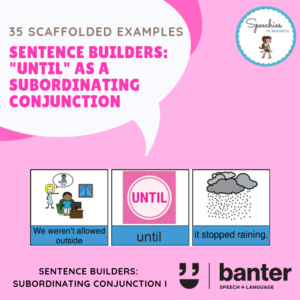 (L250) Sentence builders: "Until" as a Subordinating Conjunction
