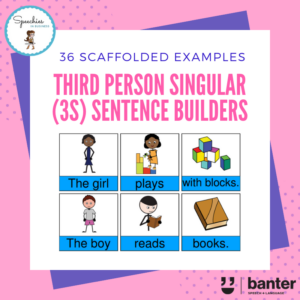


(L266) Verbs: Third Person Singular (3S) (Present Tense) Verb Sentence Builders
$5.99 including GST
Around the age of 36-42 months, typically developing children start to use third person singular (present tense) forms of verbs, e.g.:
-
- The dog digs.
-
- He eats.
-
- She dances.
-
- It grows.
These are sometimes called 3S verbs.
Some people who speak English as a second language and/or have developmental language disorders need focused practice to learn and to use this grammatical form.
This 26-page no-prep pack is designed to help, with both pictures and words making it suitable for children and adults.
Description
Around the age of 36-42 months, typically developing children start to use third person singular (present tense) forms of verbs, e.g.:
-
- The dog digs.
-
- He eats.
-
- She dances.
-
- It grows.
These are sometimes called 3S verbs.
As the examples illustrate, we usually add an “s” to the end of the verb whenever speaking about what a third person is doing in present tense. Some people who speak English as a second language and/or have developmental language disorders need focused practice to learn and to use this grammatical form.
This 26-page no-prep pack is designed to help, with both pictures and words making it suitable for children and adults.

Related products
-
-
-
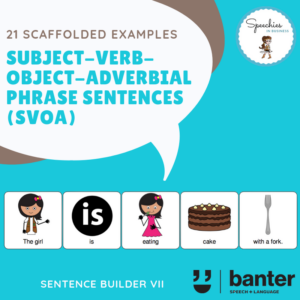
(L145) Subject-Verb-Object-Adverbial Phrase (SVOA) Sentence Builders
$5.99 including GST -
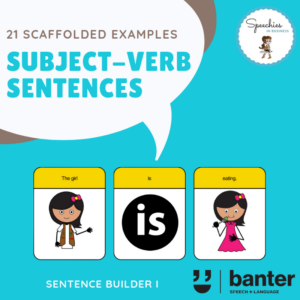
 (S124) Speech Fluency & Naturalness Practice-Readings for Students and Adults who Stutter: Volume 5 (Famous Speeches)
 (R701) NAPLAN: Year 3 - Essential Language Convention Skills for NAPLAN (Nouns and Proper Nouns)
 (S103) Lidcombe Program for Stuttering: My 10 Favourite Therapy Activities
 Carrier Phrases for Speech, Language, Stuttering and Voice Therapy
 (L129) Subject-Verb-Complement (Auditory Bombardment)
 Complex Cluster Targets for use with a Cycles Approach, Complexity Approach or Contrastive Approach
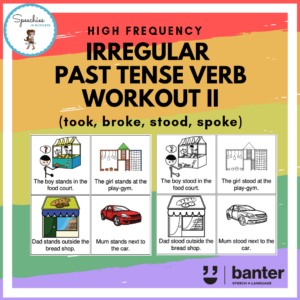 (L133) Verbs: Irregular Past Tense Verb Workout 2 (took, broke, stood, spoke)
 (L111) Subject-Verb (-ing) (Auditory bombardment)