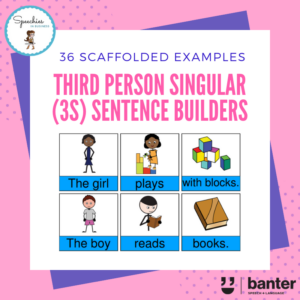


(L266) Verbs: Third Person Singular (3S) (Present Tense) Verb Sentence Builders
$5.99 including GST
Around the age of 36-42 months, typically developing children start to use third person singular (present tense) forms of verbs, e.g.:
-
- The dog digs.
-
- He eats.
-
- She dances.
-
- It grows.
These are sometimes called 3S verbs.
Some people who speak English as a second language and/or have developmental language disorders need focused practice to learn and to use this grammatical form.
This 26-page no-prep pack is designed to help, with both pictures and words making it suitable for children and adults.
Description
Around the age of 36-42 months, typically developing children start to use third person singular (present tense) forms of verbs, e.g.:
-
- The dog digs.
-
- He eats.
-
- She dances.
-
- It grows.
These are sometimes called 3S verbs.
As the examples illustrate, we usually add an “s” to the end of the verb whenever speaking about what a third person is doing in present tense. Some people who speak English as a second language and/or have developmental language disorders need focused practice to learn and to use this grammatical form.
This 26-page no-prep pack is designed to help, with both pictures and words making it suitable for children and adults.

 The No-Prep Mumble-Buster: for children who mumble and mutter
 (L235) Complex sentence picture description task: 'if' and 'while' sentences
 (A100) Sound Cards
 (F508) Zack the Zookeeper: An Alveolar-Velar Story
 Motor-speech stories for articulation movements pack 3: alveolar-alveolar and velar-velar
 No-Prep Basic Reinforcement Pack I
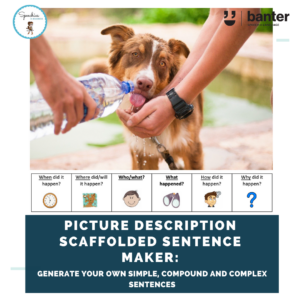 (L236) Picture Description Scaffolded Sentence Maker: generate your own simple, compound and complex sentences
 (F519) Advanced Speech Sound Exercises: Discourse Level Exercises - Alveolar Speech Sounds
 (E414) A /k/-initial aspiration trick story (for velar fronting and /k/ articulation)
 (F501) The Wolf Matthew, the Beaver, and the Moth: A Bilabial-Dental Story
 (S125) Speech Fluency & Naturalness Practice-Readings for Students and Adults who Stutter: Volume 6 (Famous Essays)
 (S113) Westmead Program for Stuttering: Activity List
 Complex Cluster Targets for use with a Cycles Approach, Complexity Approach or Contrastive Approach
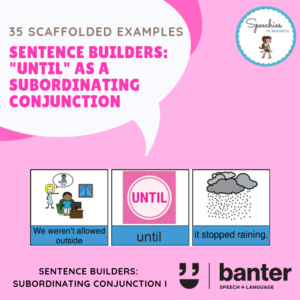
 (L232) Sentence Builders: "While" as a Subordinating Conjunction
 (S123) Speech Fluency & Naturalness Practice-Readings for Students who Stutter: Volume 4 (Tongue Twisters)
 (C302) Complexity Approach: True Clusters with a Sonority Difference of 2 (/sm/ and /sn/)
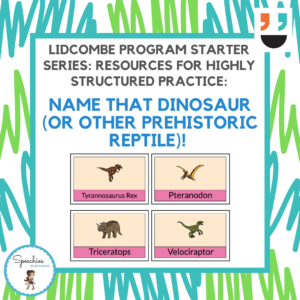 (S109) Lidcombe Program Starter Series: Resources for Highly Structured Practice: Name that Dinosaur (or other Prehistoric Reptile)!
 (S127) Lidcombe Program Starter Series: Highly Structured Practice Bundle
 (R209) CCVC Words in Sentences: Is Stan a Brat?
 (R306) Decoding Polysyllabic Words in Sentences: My Grandmother Is a Touch Unusual
 (S122) Speech Fluency & Naturalness Practice-Readings for Students who Stutter: Volume 3 (Poems)
 (S117) Picture Description Resources for Stuttering Therapy (Volume 1)
 Speech Therapy by Telehealth (Video Conferencing): Parent Guidelines
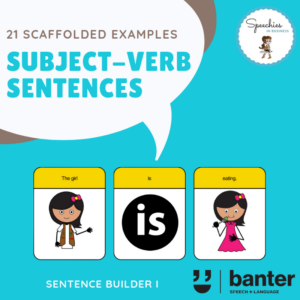
 (L111) Subject-Verb (-ing) (Auditory bombardment)
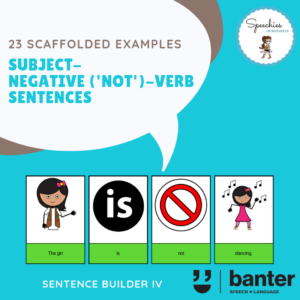 (L124) Subject-Negative ('not')-Verb (SNegV) Sentence Builders
 (S107) Lidcombe Program Starter Series: Resources for Highly Structured Practice: Say What I Say
 (S119) Picture Description Resources for Stuttering Therapy (Volume 3)
 (L242) Conjunctions - When (Auditory Bombardment)
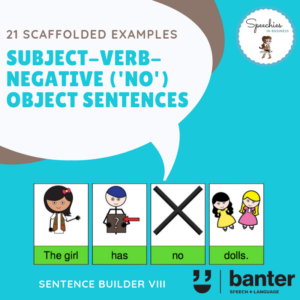 (L123) Subject Verb Negative ("No") Object (SVNegO) Sentences