
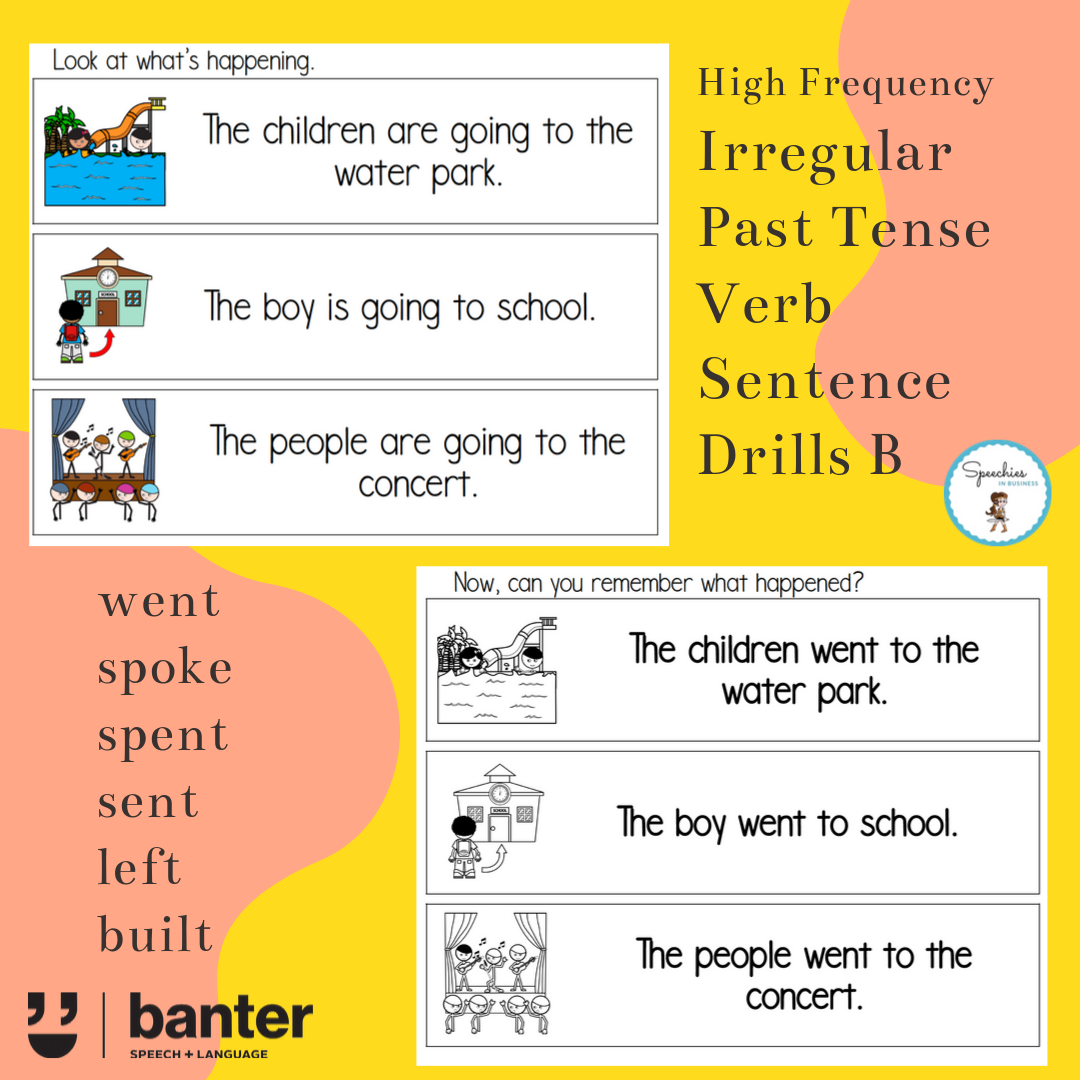


(L139) Verbs: Irregular Past Tense Verb Sentence Drills B: went, spoke, spent, sent left built
$5.99 including GST
In this 28-page no-prep drill pack, we cover six of the highest frequency verbs in English with irregular past tense forms. We tackle them one at a time, with lots of repetition. Then we mix them together for extra practice. Here’s what we cover in this pack:
- went
- spoke
- spent
- sent
- left
- built
Description
At around 30-36 months of age, typically developing children start to use irregular past tense verbs such as came, fell, broke, sat, and went in sentences. For many people – including people learning English as a second language and people with language disorders – learning irregular past tense verbs is a huge challenge. Unfortunately, many of the highest frequency verbs in English have irregular past tense forms.
To help people to learn irregular past tense verbs methodically, we’ve reviewed the New General Service List-Spoken (Brown & Culligan, 2013): a list containing 721 words providing up to 90% coverage for unscripted spoken English. We’ve extracted the 57 most frequent irregular verbs in spoken English, and then sorted them into 10 broad groups.
In this 28-page no-prep drill pack, we cover six of the highest frequency verbs in English with irregular past tense forms. We tackle them one at a time, with lots of repetition. Then we mix them together for extra practice. Here’s what we cover in this pack:
- went
- spoke
- spent
- sent
- left
- built
For more irregular past tense verb sentence drills, check out our Drills Pack A (made, ate, came, took, broke, stood) and Drills Pack C (knew, grew, drew, threw, flew, blew).

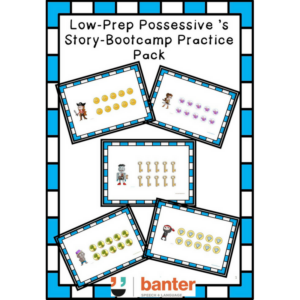 (L263) Low-Prep Possessive ’s Story-Bootcamp Practice Pack
 (S112) Westmead Program for Stuttering: Robot Talking Activity Log
 Mentor Meeting Agenda
 (R806) Think Then Write Workbook 5: Multi-Paragraph Information Report Writing Foundations
 (S118) Picture Description Resources for Stuttering Therapy (Volume 2)
 (L103) Once upon a....what? A no-preparation resource to focus on the meaning of "what" questions in context
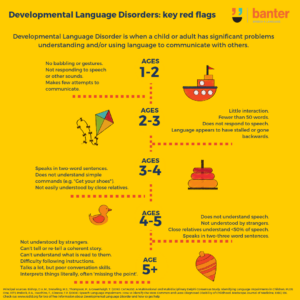 Developmental Language Disorder: Key Red Flags
 (R810) Book Hacker: How to read a book to understand it quickly
 (R413) The Scatter-Slayer Adventures: Book 1 – Don’t Stay! Be Afraid!
 Speech Therapy by Telehealth (Video Conferencing): Parent Guidelines
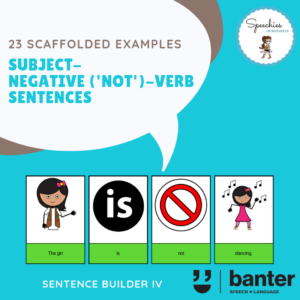 (L124) Subject-Negative ('not')-Verb (SNegV) Sentence Builders
 (R702) Essential Language Convention Skills (Capital Letters and Full Stops)
 (A108) Speech Sound Pack (Initial, Medial and Final) - /k/
 (L242) Conjunctions - When (Auditory Bombardment)
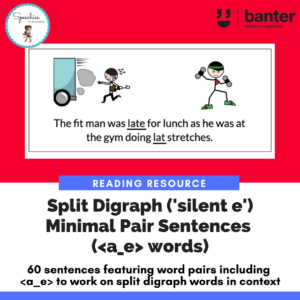 (R308) Reading Resource: Split Digraph ('silent e') Minimal Pair Sentences: a_e words
 (S127) Lidcombe Program Starter Series: Highly Structured Practice Bundle
 Complex Cluster Targets for use with a Cycles Approach, Complexity Approach or Contrastive Approach
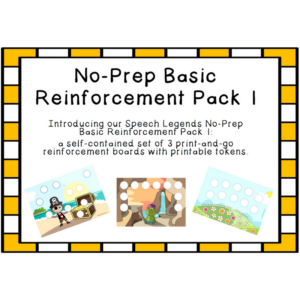 No-Prep Basic Reinforcement Pack I
