


(R216) Early sound blending practice 6: CCVCC words – starting with a continuant
$5.99 including GST
Now that the student has learned to decode and encode simple CVC, CCVC and CVCC words composed on the basic code, we step up to working with consonant-consonant-vowel-consonant-consonant (CCVCC) word structures composed of high frequency letter-sound links.
Why blending? Learning to decode letters into speech sounds, and then to blend the speech sounds together to form words is a fundamental reading skill for all students in their first year of schooling.
Why read and write the words? Early encoding (writing) practice helps consolidate early decoding (reading) skills (and vice versa).
Description
Why blending? Learning to decode letters into speech sounds, and then to blend the speech sounds together to form words is a fundamental reading skill for all students in their first year of schooling.
Why the basic code? Now that the student has learned to decode and encode simple CVC, CCVC and CVCC words composed on the basic code, we step up to working with consonant-consonant-vowel-consonant-consonant (CCVCC) word structures composed of high frequency letter-sound links.
Why start the words with continuants? A continuant is a consonant which is sounded with the vocal tract partly closed, which allows the breath to pass through and for the speech sound to be stretched or prolonged (e.g. /f, l, m, n, r, s/ and /v/). They’re easier to blend for beginners than words that start with short ‘stops’ like <b>, <d> or <g>.
Why read and write the words? Early encoding (writing) practice helps consolidate early decoding (reading) skills (and vice versa).
This no-prep resource can be downloaded in PDF and Google Slides formats.
Related resources:
- Early sound blending practice 1: CVC words with short a and e vowels
- Early sound blending practice 2: CVC words with short i and o vowels
- Early sound blending practice 3: CVC words with short u vowel
- Early sound blending practice 4: CCVC words – starting with a continuant
- Early sound blending practice 5: CVCC words – starting with a continuant
- The b/d letter-sounds sorter (with CVC words, sentence and story workout)
- CCVC Words in Sentences: Is Stan a brat?
- CVCC Words in Sentences: Wendy has zest!
- Early Reading Workout – Stan has three cats: Dom, Don and Dan (CVC, CVCC, CCVC)
- Split digraph minimal pair sentences
- Polysyllabic words in sentences
For free, decodable stories focusing on the basic code, check out: Is your Kindy kid really reading? Find out with our 7 free mini stories.

Related products
-
-

-
-
(R703) Think, Then Write Workbook 4: Paragraph Writing Foundations
$65.00 including GST
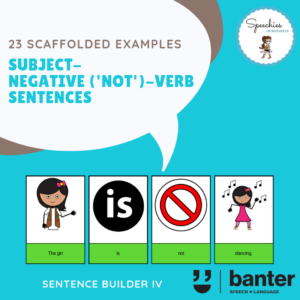 (L124) Subject-Negative ('not')-Verb (SNegV) Sentence Builders
 (S124) Speech Fluency & Naturalness Practice-Readings for Students and Adults who Stutter: Volume 5 (Famous Speeches)
 Motor-speech stories for articulation movements pack 3: alveolar-alveolar and velar-velar
 (L273) Sentence builders: "Although" as a Subordinating Conjunction
 (L133) Verbs: Irregular Past Tense Verb Workout 2 (took, broke, stood, spoke)
 (A100) Sound Cards
 (F508) Zack the Zookeeper: An Alveolar-Velar Story
 (R414) The Zoo Druid
 (L250) Sentence builders: "Until" as a Subordinating Conjunction
 (L106) Pronouns: He/She - Subjective Pronouns No-Prep Workout Pack
 (L108) Once upon a....whose? A no-preparation resource to focus on the meaning of "whose" questions in context
 (L111) Subject-Verb (-ing) (Auditory bombardment)
 (E411) Slushy /s/ Zapper: A Lateral Lisp Treatment Resource
 (L229) Conjunctions - Because (Auditory bombardment)
 Carrier Phrases for Speech, Language, Stuttering and Voice Therapy
 (L121) Subject-Verb-Object (-ing) (Auditory Bombardment)
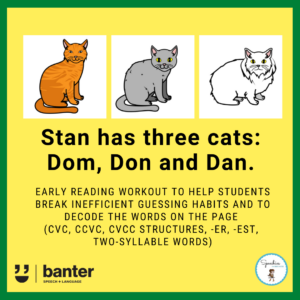 (R215) Early Reading Workout - Stan has three cats: Dom, Don and Dan (CVC, CVCC, CCVC)
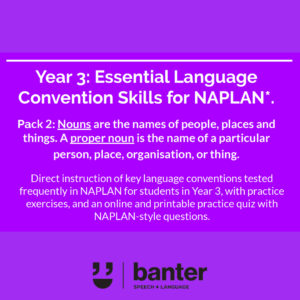 (R701) NAPLAN: Year 3 - Essential Language Convention Skills for NAPLAN (Nouns and Proper Nouns)
