


(S119) Picture Description Resources for Stuttering Therapy (Volume 3)
$5.99 including GST
This Volume 3, 40-page ‘no-preparation’ pack features 30 interesting, high-quality photographs that can be used for picture description tasks at all levels – from single words, all the way up to making inferences. The resource is suitable for face-to-face practice and telehealth (via video conferencing platforms such as Zoom, Coviu and Skype).
Obviously, you want to pitch your questions about the pictures at a level that will promote your student’s or child’s fluency. To help find the right level of question to ask, we have adapted Marion Blank’s four levels of questioning. This model is based on the idea that kids first learn to understand and use language in very concrete ways based on what they see, hear and touch.
Description
For children who stutter, it can be hard to find the right tools to help.
Picture description tasks are great for working on speech fluency. Picture descriptions help foster joint attention for highly structured practice (like during Stage 1 of the Lidcombe Program), through to sentence level practice, and all the way up to conversation level speech. Picture description tasks can also be used to stimulate language development.
This Volume 3, 40-page ‘no-preparation’ pack features 30 interesting, high-quality photographs that can be used for picture description tasks at all levels – from single words, all the way up to making inferences. The resource is suitable for face-to-face practice and telehealth. It can be printed, displayed on a computer, iPad or other tablet, phone or other smart device, or shared onscreen via telehealth video conferencing platforms such as Zoom, Coviu and Skype.
Obviously, you want to pitch your questions about the pictures at a level that will promote your student’s or child’s fluency. To help find the right level of question to ask, we have adapted Marion Blank’s four levels of questioning. This model is based on the idea that kids first learn to understand and use language in very concrete ways based on what they see, hear and touch, etc.
As they develop, kids learn to use language to understand and express more abstract ideas (e.g. to make predictions, draw inferences, and to explain ideas and events that you can’t see, smell or touch). You can read more about this framework here.
Here are Volume 1 and Volume 2 if you haven’t checked them out already.
For more Lidcombe Program resources, check out our:
- Lidcombe Program Starter Series: Highly Structured Practice: Say What I Say
- Lidcombe Program Starter Series: Highly Structured Practice: Noun & Verb Naming
- Lidcombe Program Starter Series: Highly Structured Practice: Categories Bingo
- Lidcombe Program Starter Series: Highly Structured Practice: Start Your Engines!
- Lidcombe Program Stuttering Activities: Volume 2
For Westmead Program resources, check out our Westmead Program for Children who Stutter: Introduction & Carrier Phrase Workout.
Other related resources:
- No-Prep Stuttering-Expressive Language Pack
- Stuttering Superhero Cards
- Stuttering and fluency wellness snapshot for school-aged children who stutter
We use this resource in our speech pathology clinic. We hope you find this resource as helpful as we do.

Related products
-

(S126) Camperdown Program for Adults who Stutter: Practice Goal Setter
$0.00 including GST -
Sale!

Speech Therapy by Telehealth (Video Conferencing): Parent Guidelines
Original price was: $4.99.$0.00Current price is: $0.00. including GST -

-

 (R612) High Frequency Suffixes for Reading and Writing: "-ible"
 (R423) The Scarecrow and Bear Fair in the Land of Nowhere
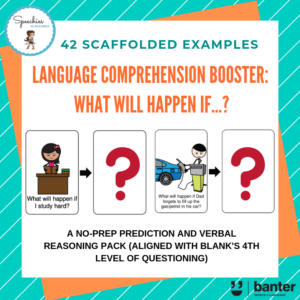 (L404) Blanks 4: Language comprehension booster: What will happen if...?
 (L267) Can I...? Questions (Auditory bombardment)
 (R209) CCVC Words in Sentences: Is Stan a Brat?
 (R310) Reading Resource: Split Digraph ('silent e') Minimal Pair Sentences: o_e words
 (L242) Conjunctions - When (Auditory Bombardment)
 (L101) Barrier Activities - Basic English Core Vocabulary: Nouns 1
 (R305) Decoding Polysyllabic Words in Sentences: My Mother Is Impressive
 (R309) Reading Resource: Split Digraph ('silent e') Minimal Pair Sentences: i_e words
 Carrier Phrases for Speech, Language, Stuttering and Voice Therapy
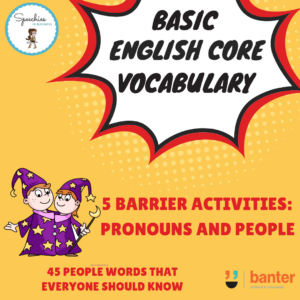 (L144) Barrier Activities - Basic English Core Vocabulary: Pronouns and People
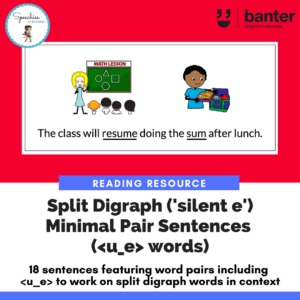 (R311) Reading Resource: Split Digraph ('silent e') Minimal Pair Sentences: u_e words
 (R210) Early sound blending practice 5: CVCC words - starting with a continuant
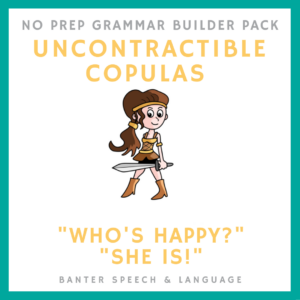 (L264) The No Prep Grammar Builder: Uncontractible Copulas (“Who’s happy?” “She is!”)
 (L214) Following Directions Workout 1
 (L229) Conjunctions - Because (Auditory bombardment)
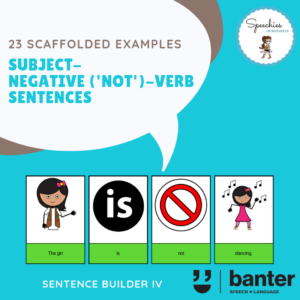 (L124) Subject-Negative ('not')-Verb (SNegV) Sentence Builders
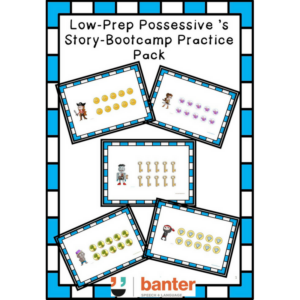 (L263) Low-Prep Possessive ’s Story-Bootcamp Practice Pack
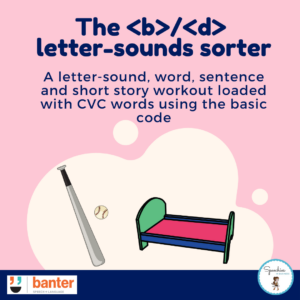 (R206) b/d letter-sounds sorter (a letter-sound, word, sentence and short story workout with CVC words)
 (R216) Early sound blending practice 6: CCVCC words - starting with a continuant
 (R507): Think Then Write Workbook 1: Simple Sentences
 The No-Prep Mumble-Buster: for children who mumble and mutter
 (A100) Sound Cards
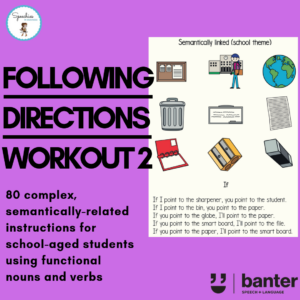 (L215) Following Directions Workout 2
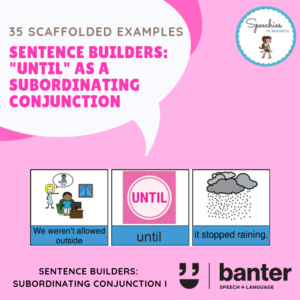 (L250) Sentence builders: "Until" as a Subordinating Conjunction
