


(L273) Sentence builders: “Although” as a Subordinating Conjunction
$5.99 including GST
In this 25-page no-prep pack of sentences, we provide several scaffolded examples of “although sentences”.
Part A of the pack contains 37 examples of sentences containing “although” as a conjunction. Both words and pictures are used to support people who are learning to use “although”.
In Part B, we present several sentence fragments for users to complete using their knowledge of “although” to link ideas while connoting contrast.
Description
Like “but”, “yet” and “still”, the word “although” – when used as a conjunction – shows contrast between two ideas. “Although” is a powerful word to use in writing assignments for school students, and in written work produced by adults in all sorts of work and life tasks, including emails. For example:
“Although I am usually shy, I gave the speech confidently.”
“Although it was dark, I could see the house clearly in the distance.”
“Although” has many uses; and is especially helpful in persuasive writing tasks. It’s used frequently when making an argument, when comparing and contrasting ideas, when evaluating the pros and cons of proposals, when evaluating objects, people, or ideas, when criticising things and ideas, when making complaints, and when building a case or argument. In other words, “although” is a useful verbal reasoning tool to link ideas by contrast, with wide application across the curriculum, and in everyday and work-related writing activities.
In this no-prep pack of sentences, we provide several scaffolded examples of “although sentences”.
Part A of the pack contains 37 examples of sentences containing “although” as a conjunction. Both words and pictures are used to support people who are learning to use “although”.
In Part B, we present several sentence fragments for users to complete using their knowledge of “although” to link ideas while connoting contrast.

Related products
-
-
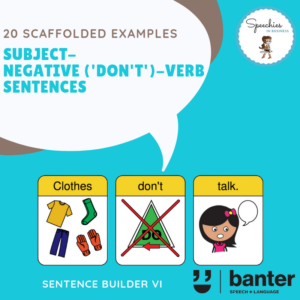
(L126) Subject-Negative (‘Don’t’)-Verb (SNegV Don’t) Sentence Builders
$5.99 including GST -
-
 (D405) Stopping Pack
 (S125) Speech Fluency & Naturalness Practice-Readings for Students and Adults who Stutter: Volume 6 (Famous Essays)
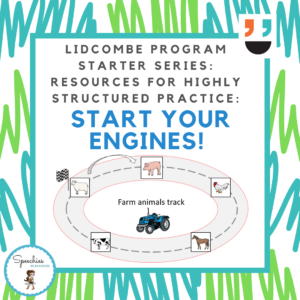 (S108) Lidcombe Program Starter Series: Resources for Highly Structured Practice: Start Your Engines!
 (R513) High frequency words you need to get right when you write - Volume 1: The Six 'Wh' words
 (S128) Speech Fluency & Naturalness Practice for Students and Adults who Stutter: Volume 7 (Impromptu Speaking Discussion Topics)
 (L264) The No Prep Grammar Builder: Uncontractible Copulas (“Who’s happy?” “She is!”)
 (R416) The Glowing Toad
 (R614) High Frequency Suffixes for Reading and Writing: "-our" or "-or"
 (R509) Think, Then Write Workbook 2: FANBOYS Compound Sentences
 (R422) The Spoiled Boy
 (S114) Stuttering Superhero Cards
 (R810) Book Hacker: How to read a book to understand it quickly
 (S121) Speech Fluency & Naturalness Practice-Readings for Students who Stutter: Volume 2 (Short Poems)
 (R703) Think, Then Write Workbook 4: Paragraph Writing Foundations
 (R414) The Zoo Druid
 (R304) Decoding Polysyllabic Words in Sentences: My Dad Does Several Silly Things
 (R209) CCVC Words in Sentences: Is Stan a Brat?
 (L267) Can I...? Questions (Auditory bombardment)
 (B209) Cycles Approach: /r/ initial Pack
 (B206) Cycles Approach: Velars Pack (/k/ initial and final, /g/ initial)
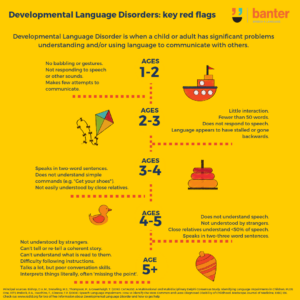 Developmental Language Disorder: Key Red Flags
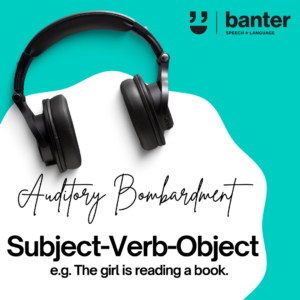 (L121) Subject-Verb-Object (-ing) (Auditory Bombardment)
 (L270) Verbs: Future Tense Verbs: Auxiliary Verb "going to" (e.g. "The girl is going to sing")
 (B208) Cycles Approach: /l/ initial Pack
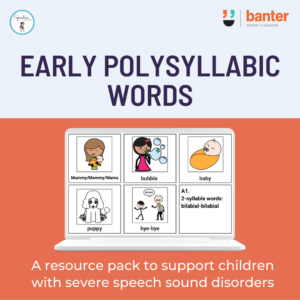 (B210) Early polysyllabic words: a resource pack to support children with severe speech sound disorders
 (L306) "What is it"? Foundations: Objects in Familiar Environments
 Speech Therapy by Telehealth (Video Conferencing): Parent Guidelines
 (R306) Decoding Polysyllabic Words in Sentences: My Grandmother Is a Touch Unusual
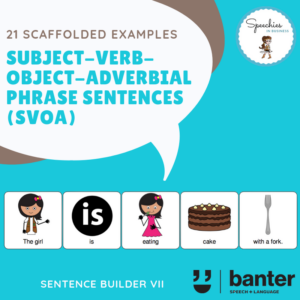 (L145) Subject-Verb-Object-Adverbial Phrase (SVOA) Sentence Builders
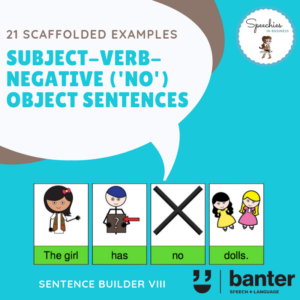 (L123) Subject Verb Negative ("No") Object (SVNegO) Sentences
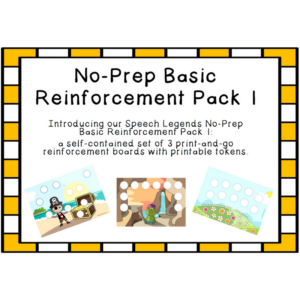 No-Prep Basic Reinforcement Pack I
 Carrier Phrases for Speech, Language, Stuttering and Voice Therapy
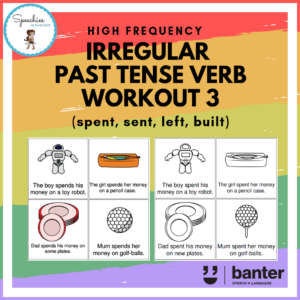 (L134) Verbs: Irregular Past Tense Verb Workout 3 (spent, sent, left, built)
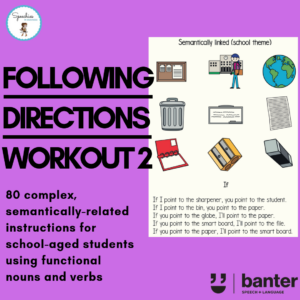 (L215) Following Directions Workout 2
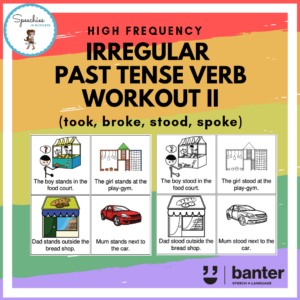 (L133) Verbs: Irregular Past Tense Verb Workout 2 (took, broke, stood, spoke)
