


(L534) Social idioms in action: To let it go
$5.99 including GST
GIF-based video models of social idioms in context. In this 12-page no-prep resource we focus on the idiom: ‘To let it go’.
In this resource we explain, with the help of GIFs, the idiom ‘to let it go’, contrast ‘to let it go’ with examples of not letting it go, discuss why it’s important to let it go, and remind students that bullying is never okay.
To play the GIFs, copy the slides onto your Google Drive.
Description
GIF-based video models of social idioms in context. In this 12-page no-prep resource we focus on the idiom: ‘To let it go’.
An idiom is a group of words which have a different meaning when used together from the one they would have if you took the meaning of each word separately. For example:
“To feel wiped-out!” means your body and mind are exhausted!
“To scratch your head!” means “to be puzzled and unsure about a problem or question, or to not know the answer to a problem”.
As children get older, they may notice that their parents, teachers and friends using lots of idioms in conversation.
In this resource we explain, with the help of GIFs, the idiom ‘to let it go’, contrast ‘to let it go’ with examples of not letting it go, discuss why it’s important to let it go, and remind students that bullying is never okay.
To play the GIFs, copy the slides onto your Google Drive.
Related resources:
-
- Social idioms in action: Don’t sound like a broken record
- Social idioms in action: On the same page
- Social idioms in action: To lend someone a hand
- Social idioms in action: Hang in there!
- Social idioms in action: I have your back
- Social idioms in action: Be a good sport
- Social Use of Language Picture Discussion Pack
- Blank’s Level 4 and Theory of Mind Questions Picture Resource
- Theory of Mind: We are all different, and like different things. That’s OK!

 (L263) Low-Prep Possessive ’s Story-Bootcamp Practice Pack
 (S112) Westmead Program for Stuttering: Robot Talking Activity Log
 Mentor Meeting Agenda
 (R806) Think Then Write Workbook 5: Multi-Paragraph Information Report Writing Foundations
 (S118) Picture Description Resources for Stuttering Therapy (Volume 2)
 (L103) Once upon a....what? A no-preparation resource to focus on the meaning of "what" questions in context
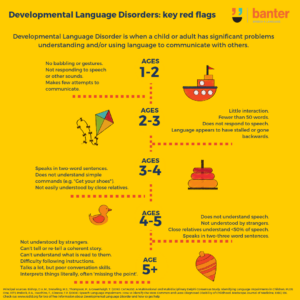 Developmental Language Disorder: Key Red Flags
 (R810) Book Hacker: How to read a book to understand it quickly
 (R413) The Scatter-Slayer Adventures: Book 1 – Don’t Stay! Be Afraid!
 Speech Therapy by Telehealth (Video Conferencing): Parent Guidelines
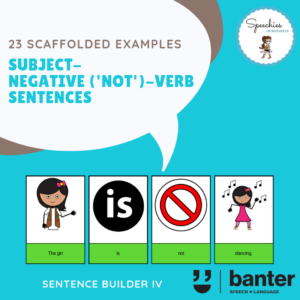 (L124) Subject-Negative ('not')-Verb (SNegV) Sentence Builders
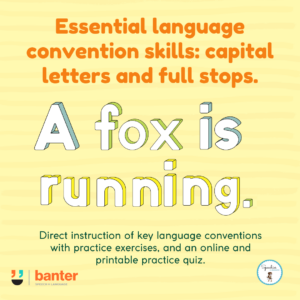 (R702) Essential Language Convention Skills (Capital Letters and Full Stops)
 (L121) Subject-Verb-Object (-ing) (Auditory Bombardment)
 (A108) Speech Sound Pack (Initial, Medial and Final) - /k/
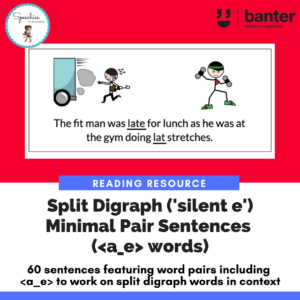 (R308) Reading Resource: Split Digraph ('silent e') Minimal Pair Sentences: a_e words
 (S127) Lidcombe Program Starter Series: Highly Structured Practice Bundle
 Complex Cluster Targets for use with a Cycles Approach, Complexity Approach or Contrastive Approach
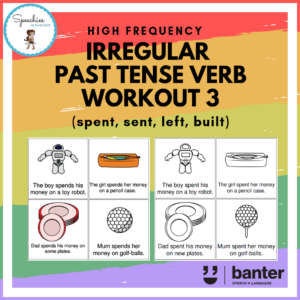 (L134) Verbs: Irregular Past Tense Verb Workout 3 (spent, sent, left, built)

Reviews
There are no reviews yet.