


(S120) Speech Fluency & Naturalness Practice-Readings for Students who Stutter: Volume 1 (Nonsense Verses)
$5.99 including GST
These 10 short nonsense verses are designed to provide students who stutter with speech practice.
The aim is to speak both fluently, but also naturally. With built-in short phrases, they can be used to practice speech in the clinic and at home. They can also be “performed” anywhere and recorded by the student for later review of speech fluency and naturalness, e.g. using video modelling.
Description
Dr J. Scott Yaruss, a stuttering expert at Michigan State University, once said that most stuttering management techniques involve changing either the timing or tension of speech movements – or both.
Many school-aged children who stutter who have worked through an evidence-based treatment like the Westmead Program, Time Out, or the Camperdown Program, need to practice their techniques, not just so they can speak fluently in the clinic, but so they can sound natural in the real world: like themselves.
In truth, recovery means different things to different people – including to different people who stutter. For many students, requiring completely fluent speech as a criteria for recovery is unrealistic and potentially demotivating and demoralising. Ultimately, the most important view is the student’s, recognising that there is as yet no cure for persistent stuttering although many people are working on it.
Experienced speech pathologists know that, if students don’t sound natural, they are unlikely to use their speech techniques out in the real world, even if their speech is 100% fluent.
In clinical practice, working to transfer fluency gains to the real world often involves working with students to “shape” less natural but fluent speech (using techniques like syllable timed or prolonged speech) into more natural sounding speech that is slightly modified.
Finding a mix of techniques that work for an individual student takes a lot of work and experimentation – both for the student and the speech pathologist. In general, more natural speech can be achieved with a slightly reduced rate, reduced physical tension only at the beginnings of phrases, and the use of short phrases, with pauses between phrases.
It goes without saying, but learning to be both fluent and natural sounding takes a lot of practice.
These 10 short nonsense verses are designed to provide students with speech practice. The aim is to speak both fluently, but also naturally. With built-in short phrases, they can be used to practice speech in the clinic and at home. They can also be “performed” anywhere and recorded by the student for later review of speech fluency and naturalness, e.g. using video modelling.
Related resources:
- Westmead Program for Children who Stutter: Introduction & Carrier Phrase Workout
- Camperdown Program for Adults who Stutter: Practice Goal Setter
- Stuttering Superhero Cards
- Stuttering and fluency wellness snapshot for school-aged children who stutter

Related products
-
Sale!

(S127) Lidcombe Program Starter Series: Highly Structured Practice Bundle
Original price was: $29.95.$27.99Current price is: $27.99. including GST -

(S126) Camperdown Program for Adults who Stutter: Practice Goal Setter
$0.00 including GST -

-

(S119) Picture Description Resources for Stuttering Therapy (Volume 3)
$5.99 including GST
 Social Media Platform House Rules
 Reference Letter Templates
 Letter of Introduction to Educators
 Business Networking Letters
 (N106) Code of Conduct for NDIS Providers and Health Providers
 (N107) NDIS Service Agreement Template 2025-26
 Australian SLP Private Practice Business Planning Kit including One-Page Business Plan
 Client Intake Form
 From Launch to Waitlist
 Letter of thanks to client
 Mentor Meeting Agenda
 Letter turning down a client (politely)
 Letter of Introduction to Doctors
 Progress Note System (Therapy)
 Weekly Session Planner
 Session Plan and Data Collection Worksheet
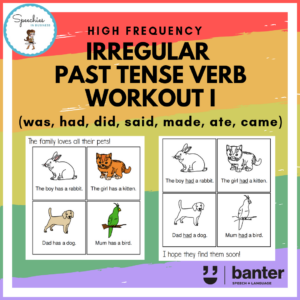 (L132) Verbs: Irregular past tense verb workout 1 (was, had, did, said, made, ate, came)
 (R414) The Zoo Druid
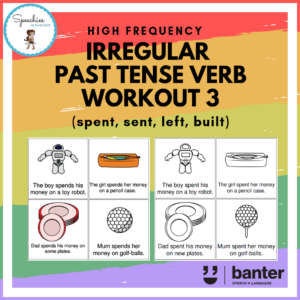 (L134) Verbs: Irregular Past Tense Verb Workout 3 (spent, sent, left, built)
 (L267) Can I...? Questions (Auditory bombardment)
 (L502) Listen then Speak 2: an oral language workout for students in Years 2-5
