


(S111) Westmead Program for Children who Stutter: Introduction & Carrier Phrase Workout
$11.00 including GST
This scripted and no-prep 35-page resource is designed to help speech pathologists to introduce the Westmead Program to families of children who stutter and to start practising syllable timed speech. It features:
* multiple speech model recordings;
* several structured speech exercises, including carrier phrase prompts with pictures, picture description tasks, questions aligned with Marion Blank’s 2nd, 3rd, and 4th Levels of questioning, procedure prompts, ‘Would you rather…?’ questions, and a story generation task;
* activity suggestions to do the home practice; and
* a home practice log.
We designed this resource to make the early stages of treatment easier for speech pathologists, families and students. This resource is formatted to be presented using Google Slides, PowerPoint, PDF, and can be presented on any compatible electronic device.
Description
Syllable-timed speech techniques (STS) to treat stuttering like the Westmead Program have been used (in different forms) for hundreds of years. They involve speaking with very little difference in stress across syllables. This is achieved by saying each syllable with equal stress to a rhythmic beat – almost like – you guessed it – a robot.
The Westmead Program is different from some of the older STS treatments in that it doesn’t require:
-
- any props, e.g. metronomes, to set or maintain the beat;
- the child to speak very slowly or in a monotone voice (children are instead encouraged to speak at a near-normal normal rate with pitch variation); or
- the child to start with single sounds, syllables and words and work slowly up to conversation in several pre-programmed steps.
This scripted and no-prep 35-page resource is designed to help speech pathologists to introduce the program to families of children who stutter and to start practising syllable timed speech. It features:
-
- multiple speech model recordings;
- several structured speech exercises, including carrier phrase prompts with pictures, picture description tasks, questions aligned with Marion Blank’s 2nd, 3rd, and 4th Levels of questioning, procedure prompts, ‘Would you rather…?’ questions, and a story generation task;
- activity suggestions to do the home practice; and
- a home practice log.
We designed this resource to make the early stages of treatment easier for speech pathologists, families and students. This resource is formatted to be presented using Google Slides and PDF, and can be presented on any compatible electronic device.
The Westmead Program for children who stutter was developed by researchers at the Australian Stuttering Research Centre at the University of Technology Sydney. You can read more about the Westmead Program, and the evidence supporting it here and here. The Westmead Program is designed to be delivered by parents who have been trained by a qualified speech pathologist with knowledge of, and experience with, the program.
Key paper: Trajkovski, N., Andrews, C., Onslow, M., O’Brian, S., Packman, A., Menzies, R. (2011). A phase II trial of the Westmead Program: Syllable-timed speech treatment for pre-school children who stutter. International Journal of Speech-Language Pathology, 13(6): 500-509.
Related resources:

Related products
-

-
Sale!

(S127) Lidcombe Program Starter Series: Highly Structured Practice Bundle
Original price was: $29.95.$27.99Current price is: $27.99. including GST -

-

(S118) Picture Description Resources for Stuttering Therapy (Volume 2)
$5.99 including GST
 Word Learner
 (L134) Verbs: Irregular Past Tense Verb Workout 3 (spent, sent, left, built)
 (L133) Verbs: Irregular Past Tense Verb Workout 2 (took, broke, stood, spoke)
 (L277) School Readiness Oral Language and Pre-Literacy Essentials
 (L214) Following Directions Workout 1
 (L314) Verbs: Regular Past Tense Verbs 2: when "ed" is pronounced as /d/
 (L310) Blanks 3: How are things the same?
 (L207) Blanks 2: What can you do with a...
 (L278) Concepts in action: Empty (a level 2 quantity concept)
 (L263) Low-Prep Possessive ’s Story-Bootcamp Practice Pack
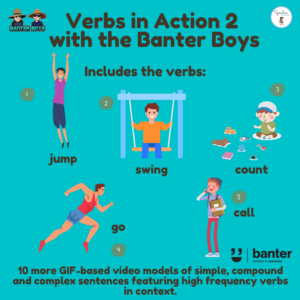 (L110) Verbs in Action 2: GIF-based video models of simple, compound and complex sentences
 (L538) 10 things for students to know about Australia: a background knowledge and language refresher
 (S121) Speech Fluency & Naturalness Practice-Readings for Students who Stutter: Volume 2 (Short Poems)
 (R216) Early sound blending practice 6: CCVCC words - starting with a continuant
 (L280) Concepts in action: Same (a level 2 quality concept)
 (L330) Concepts in action: Frightened (a level 3 feelings concept)
 (R207) Early sound blending practice 4: CCVC words - starting with a continuant
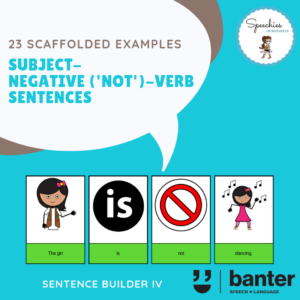 (L124) Subject-Negative ('not')-Verb (SNegV) Sentence Builders
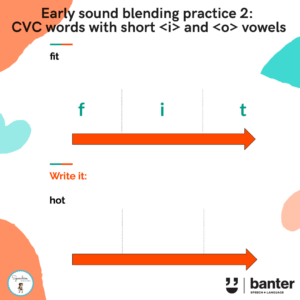 (R202) Early sound blending practice 2: CVC words with short i and o vowels
 (L328) Concepts in action: Angry (a level 3 feelings concept)
 (L307) Blanks 3: School readiness and early school vocabulary: “What is it?"
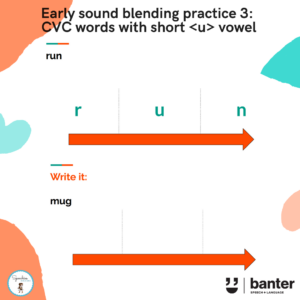 (R203) Early sound blending practice 3: CVC words with short u vowel
 (L254) Auditory Bombardment: Conjunctions - As
 (R806) Think Then Write Workbook 5: Multi-Paragraph Information Report Writing Foundations
 (L251) Auditory bombardment: Conjunctions – Until
 (L253) No Prep, Evidence-Based Conjunction Pack: 'As'
 (R419) The Shark Arcade
 (L121) Subject-Verb-Object (-ing) (Auditory Bombardment)
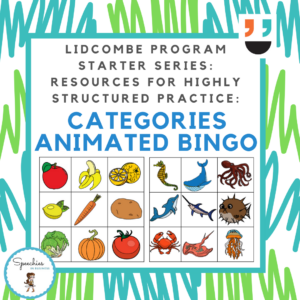 (S106) Lidcombe Program Starter Series: Resources for Highly Structured Practice: Categories Animated Bingo
