


(L312) Blanks 3: Following Directions – Functional Practice: “Do X, then Y”
$5.99 including GST
This 20-page pack includes lots of two-step directions linked by “then” that kids have to act out in the real world. For some kids, simply reading out the instructions will suffice. For students with more significant delays and disorders, picture cues are included.
These instructions can be “mixed and matched” to generate thousands of different two-step instructions. Cut up the cue cards to have students generate their own instructions for peers to practice giving instructions.
Description
Some researchers think that up to 15% of young school kids don’t have the language comprehension skills to cope fully with the demands of school (Hart & Fielding-Barnsley, 2009). One area in which many kids struggle is with following directions or instructions.
The ability to follow multi-step instructions is a big advantage. It helps to carry out learning activities and to succeed in tests. It can make you seem more diligent and responsible (especially to teachers and peers). And it can help you to navigate to new places and to deal with new situations.
Many children and adults struggle to follow multi-step instructions, including many people with developmental language disorders and working memory issues. Following long instructions requires you to hold all the detailed content of the sequence while monitoring yourself carrying them out at the same time.
Many teachers and speech pathologists practice directions with “point to the X” type of activities. These activities can be helpful when working on vocabulary and language concepts. But a more functional approach is to ask kids to remember the later steps while they attend to earlier steps “in the real world”. When the time needed to complete the instructions exceeds the duration of your working memory, you have to actively maintain the instructions in your working memory, e.g. by rehearsal (retelling yourself the instruction out loud or “in your head”, over and over) (e.g. Camos et al., 2009).
This simple 20-page pack includes lots of two-step directions linked by “then” that kids have to act out in the real world. For some kids, simply reading out the instructions will suffice. For students with more significant delays and disorders, picture cues are included.
These instructions align with Blank’s Language Level 3, where children are required to look beyond what they see, hear and touch directly, and must rework the experience in accordance with the language demands of the task.
These instructions can be “mixed and matched” to generate thousands of different two step instructions. Cut up the cue cards to have students generate their own instructions for peers to practice giving instructions.
For evidence-based information about following directions, check out our article: Following instructions: why so many of us struggle with more than one step. For more information about Blank’s Language levels, check out our article: “Huh?!” The many benefits of using Blank’s Language Levels framework to help your kids to understand language for school.

Related products
-
-
-
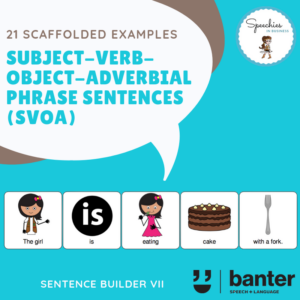
(L145) Subject-Verb-Object-Adverbial Phrase (SVOA) Sentence Builders
$5.99 including GST -

 (L273) Sentence builders: "Although" as a Subordinating Conjunction
 (L226) Sentence builders: "Because" as a Subordinating Conjunction
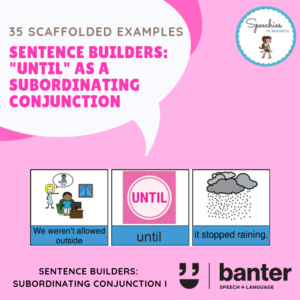 (L250) Sentence builders: "Until" as a Subordinating Conjunction
 (R414) The Zoo Druid
 (A103) Speech Sound Pack (Initial, Medial and Final) - /m/
 (A104) Speech Sound Pack (Initial, Medial and Final) - /d/
 (R419) The Shark Arcade
 (R703) Think, Then Write Workbook 4: Paragraph Writing Foundations
 (A105) Speech Sound Pack (Initial, Medial and Final) - /n/
 Complex Cluster Targets for use with a Cycles Approach, Complexity Approach or Contrastive Approach
 (R415) Attack of the Eel Beast
 Motor-speech stories for articulation movements pack 3: alveolar-alveolar and velar-velar
 (L230) Sentence builders: "If" as a Subordinating Conjunction
 No-Prep Basic Reinforcement Pack I
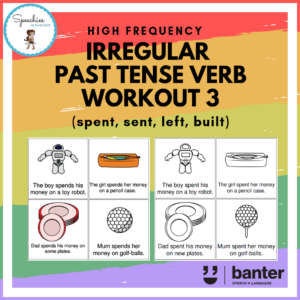 (L134) Verbs: Irregular Past Tense Verb Workout 3 (spent, sent, left, built)
 (R806) Think Then Write Workbook 5: Multi-Paragraph Information Report Writing Foundations
 (C302) Complexity Approach: True Clusters with a Sonority Difference of 2 (/sm/ and /sn/)
 (F519) Advanced Speech Sound Exercises: Discourse Level Exercises - Alveolar Speech Sounds
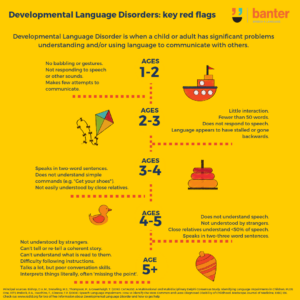 Developmental Language Disorder: Key Red Flags
