


(L204) Blanks 2: How are these things different?
$5.99 including GST
In this 34-page no-prep pack, we target a Blank’s Level 2 comprehension task. Specifically, we ask students to distinguish between two similar items by naming an attribute of each that is dissimilar. This work can also help children to classify things and to build their semantic knowledge by helping them build their knowledge of in/out groupings.
Description
Some researchers think that up to 15% of young school kids don’t have the language comprehension skills to cope fully with the demands of school (Hart & Fielding-Barnsley, 2009). Many of these kids struggle – some for their whole lives. For most kids, school and home life plays a big role in helping to understand and use language (Morgan & Goldstein, 2004; Nation, 2005). So what can we do to improve students’ understanding of language?
Well, it helps to have a plan. And good plans are based on tried and tested frameworks. For language comprehension, one of the most influential frameworks was developed by Dr Marion Blank, a developmental psychologist. Dr Blank proposed four levels of abstraction, from least to most abstract:
Level 1: Directly supplied information (Matching perception)
Level 2: Classification
Level 3: Reorganisation
Level 4: Abstraction and Inferences
Many kids start school with an ability to complete Level 1 and 2 tasks. But some don’t; and many students with limited language skills really struggle with verbs of function – naming the action performed by a given part, which can hamper oral language development and reading comprehension skills.
In this 34-page no-prep pack, we target a Blank’s Level 2 comprehension task. Specifically, we ask students to distinguish between two similar items by naming an attribute of each that is dissimilar. This work can also help children to classify things and to build their semantic knowledge by helping them build their knowledge of in/out groupings.
This exercise can be completed in any language. To make the exercise more challenging, ask the student to name two or three uses for each item.

Related products
-
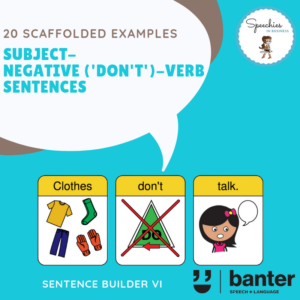
(L126) Subject-Negative (‘Don’t’)-Verb (SNegV Don’t) Sentence Builders
$5.99 including GST -
-
-

 (L320) Relative Clause Sentence Workout: That
 (R815) Interest-based Reading Comprehension Exercises for Reluctant Readers
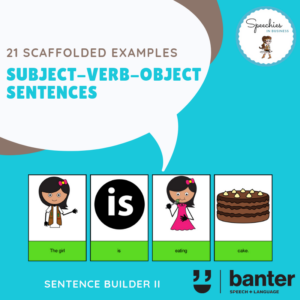 (L119) Subject-Verb-Object (SVO) Sentence Builders
 (S128) Speech Fluency & Naturalness Practice for Students and Adults who Stutter: Volume 7 (Impromptu Speaking Discussion Topics)
 (L516) Informative text language workout for primary school students: Ants and Spiders
 Carrier Phrases for Speech, Language, Stuttering and Voice Therapy
 (L402) Blanks 3 and 4 Questions Workout: MORE Brilliant Places To Go!
 (L159) Concepts in action: Happy (a level 1 feelings concept)
 (R507): Think Then Write Workbook 1: Simple Sentences
 (L117) Preposition “On”: A No-Prep Preposition Pack with Animated Examples
 (S114) Stuttering Superhero Cards
 (L155): Concepts in action: Hard (as a level 1 texture)
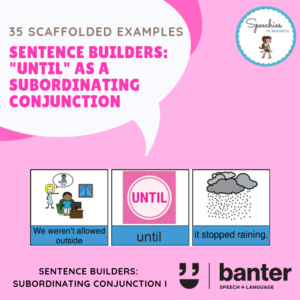 (L250) Sentence builders: "Until" as a Subordinating Conjunction
 (R701) NAPLAN: Year 3 - Essential Language Convention Skills for NAPLAN (Nouns and Proper Nouns)
 (R207) Early sound blending practice 4: CCVC words - starting with a continuant
 (L501) Listen then Speak 1: an oral language workout for students in Years 2-5
 (L412) Blanks 4 Bundle: Language Comprehension Booster - Verbal Reasoning Tasks Requiring Inferences and Abstractions
 (S113) Westmead Program for Stuttering: Activity List
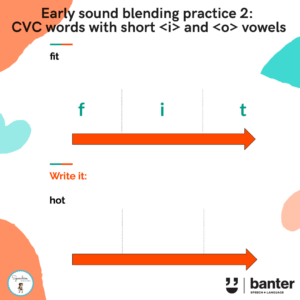 (R202) Early sound blending practice 2: CVC words with short i and o vowels
 (R509) Think, Then Write Workbook 2: FANBOYS Compound Sentences
 (R708) Think, Then Write: Christmas Writing
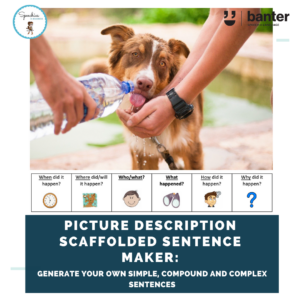 (L236) Picture Description Scaffolded Sentence Maker: generate your own simple, compound and complex sentences
 (R515) Think, Then Write: Sentence Writing Bootcamp
 (R601) High Frequency Prefixes for Reading and Writing: "Un-"
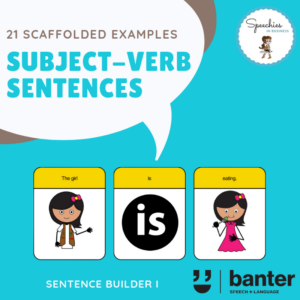 (L109) Subject-Verb (SV) Sentence Builders
 (L274) Real World Skills I: prepositions, places, home address, and directions
 (L318) "He's" and "She's" - Contractible Copula and Auxiliary Verbs Mega Workout
 (S125) Speech Fluency & Naturalness Practice-Readings for Students and Adults who Stutter: Volume 6 (Famous Essays)
 (L428) Aesop's Fables: Narrative Language Workout Bundle
 (S127) Lidcombe Program Starter Series: Highly Structured Practice Bundle
 (R402) Extended Code: My Brain Plays Every Day in Winter Bay: An 'ay', 'ai' Sentence Story Workout
 (S111) Westmead Program for Children who Stutter: Introduction & Carrier Phrase Workout
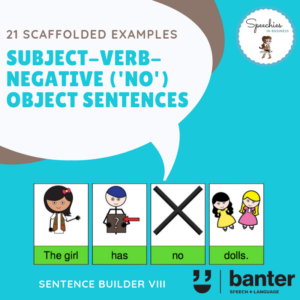 (L123) Subject Verb Negative ("No") Object (SVNegO) Sentences
 (R703) Think, Then Write Workbook 4: Paragraph Writing Foundations
 (S103) Lidcombe Program for Stuttering: My 10 Favourite Therapy Activities
 (R203) Early sound blending practice 3: CVC words with short u vowel
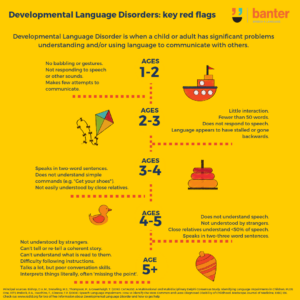 Developmental Language Disorder: Key Red Flags
 (S123) Speech Fluency & Naturalness Practice-Readings for Students who Stutter: Volume 4 (Tongue Twisters)
