


(L161) Concepts in action: Slow (a level 1 movement concept)
$5.99 including GST
11 GIF-based video models of simple, compound and complex sentences featuring early language concepts in context. The videos feature the Banter Boys and friends demonstrating foundational language concepts in a variety of ways. In this no-prep resource we focus on the concept of ‘slow’.
We also include tips, and hands-on activities for exploring concepts in the ‘real world’ with your child.
Description
11 GIF-based video models of simple, compound and complex sentences featuring early language concepts in context. The videos feature the Banter Boys and friends demonstrating foundational language concepts in a variety of ways. In this no-prep resource we focus on the concept of ‘slow’.
Way back in 1985, Ann Locke* developed a very useful framework to teach basic language concepts to young children, including concepts of size, space, texture, sound, shape, movement, quantity, time, and qualities.
As with verbs, language concepts can be difficult for some children to learn because they are often abstract and intangible.
This resource applies research showing we should teach basic language concepts:
-
- one at a time (not in pairs of opposites);
- in a developmentally appropriate order;
- using real situations, to help children to see and to experience the concepts in action; and
- in a variety of contexts so children can learn about the different ways these concepts are used in different situations (places and times).
As an example of slow movement in action:
-
- Subject Verb Complement: The snail is slow.
- Subject Verb Adverbial Phrase: The slow snail crawls across the road.
- Compound Sentence: The snail is slow and careful!
- Complex Sentence: The slow snail is careful because he doesn’t want to get eaten by a bird or stepped on by a person!
We also include tips, and hands-on activities for exploring concepts in the ‘real world’ with your child.
To play the GIFs, copy the slides onto your Google Drive.
Related resources:
* Locke, A. (1985) Living Language, NFER-Nelson

Related products
-
-
-
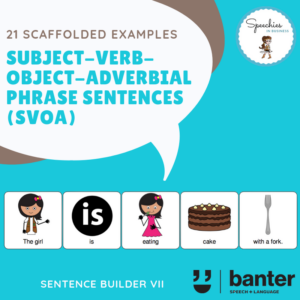
(L145) Subject-Verb-Object-Adverbial Phrase (SVOA) Sentence Builders
$5.99 including GST -
 (L235) Complex sentence picture description task: 'if' and 'while' sentences
 (R416) The Glowing Toad
 (R419) The Shark Arcade
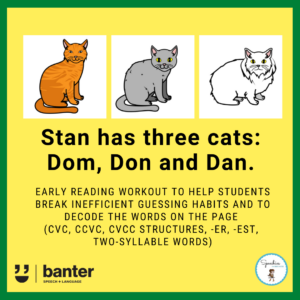 (R215) Early Reading Workout - Stan has three cats: Dom, Don and Dan (CVC, CVCC, CCVC)
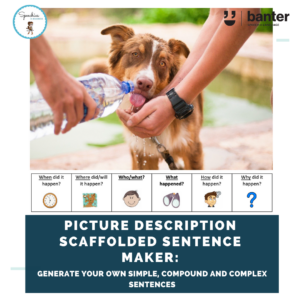 (L236) Picture Description Scaffolded Sentence Maker: generate your own simple, compound and complex sentences
 The No-Prep Mumble-Buster: for children who mumble and mutter
 (R417) The Frightening Shy Child
 (R703) Think, Then Write Workbook 4: Paragraph Writing Foundations
 (L121) Subject-Verb-Object (-ing) (Auditory Bombardment)
 Carrier Phrases for Speech, Language, Stuttering and Voice Therapy
 (R810) Book Hacker: How to read a book to understand it quickly
 (F508) Zack the Zookeeper: An Alveolar-Velar Story
 Complex Cluster Targets for use with a Cycles Approach, Complexity Approach or Contrastive Approach
 Motor-speech stories for articulation movements pack 3: alveolar-alveolar and velar-velar
 (R304) Decoding Polysyllabic Words in Sentences: My Dad Does Several Silly Things
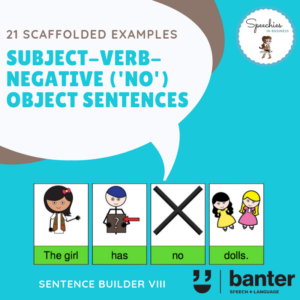 (L123) Subject Verb Negative ("No") Object (SVNegO) Sentences
 (L134) Verbs: Irregular Past Tense Verb Workout 3 (spent, sent, left, built)
 (L242) Conjunctions - When (Auditory Bombardment)
 (R414) The Zoo Druid
 (L119) Subject-Verb-Object (SVO) Sentence Builders
 (L267) Can I...? Questions (Auditory bombardment)
 (F514): Roger at the Ranch: A Palatal-Palatal Story
 (F501) The Wolf Matthew, the Beaver, and the Moth: A Bilabial-Dental Story
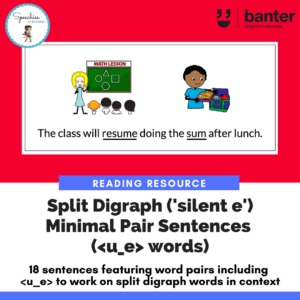 (R311) Reading Resource: Split Digraph ('silent e') Minimal Pair Sentences: u_e words
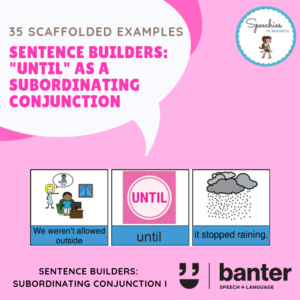 (L250) Sentence builders: "Until" as a Subordinating Conjunction
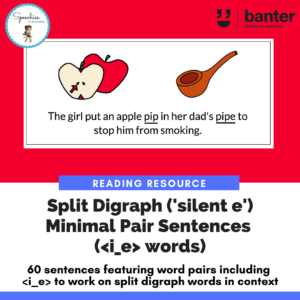 (R309) Reading Resource: Split Digraph ('silent e') Minimal Pair Sentences: i_e words
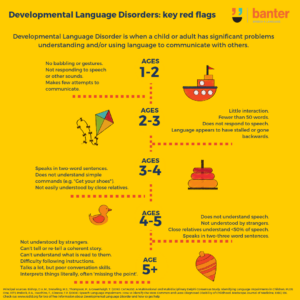 Developmental Language Disorder: Key Red Flags

Reviews
There are no reviews yet.