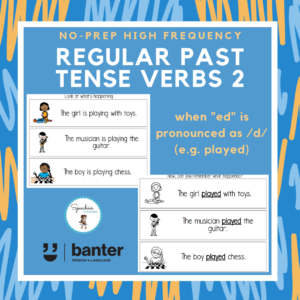


(L314) Verbs: Regular Past Tense Verbs 2: when “ed” is pronounced as /d/
$5.99 including GST
This no preparation pack is designed to provide people with structured practice using frequently used regular past tense verbs.
In this 33-page pack, we focus on adding “ed” to verbs ending in voiced sounds, where “ed” is pronounced as /d/.
With both picture cues and orthography, this pack can be used with people of all ages.
Description
At around 48-54 months, typically developing children start to use regular past tense verbs, e.g. stopped, played and lifted. Although these verbs are all spelled with an “ed” at the end, the speech sounds used to signal regular past tense vary:
- Sometimes, the “ed” is pronounced as a /t/, e.g. as in “stopped”, “bumped”, “asked”, “baked”, “hopped”, “liked”, and “walked”.
- Sometimes, the “ed” is pronounced as a /d/, e.g. as in “played”, “called”, “carried”, “rolled”, “opened”, “turned”, “showed”.
- Sometimes, the “ed” is pronounced as an “ed”, e.g. as in “counted”, “lifted”, “shouted”, and “folded”.
Most people learn the past tense form of regular verbs and the pronunciation rules without needing to be taught about them. However, people learning English as a second language and/or people with developmental language disorders sometimes don’t pick up these patterns automatically. In simple terms:
- “ed” is pronounced as /t/ when the sound before it is made without using your voice, e.g. if the base verb ends in an unvoiced sound like /p, s/ or /k/;
- “ed” is pronounced as /d/ when the sound before it is made with your voice “on”, e.g. if the base verb ends in an voiced sound like /b, z/ or /g/; and
- “ed” is pronunced as “ed” (unstressed /əd) when the sound before it is /d/ or /t/ e.g. “dented”, “needed”, “shouted,” and “wanted”.
This no preparation pack is designed to provide people with structured practice using frequently used regular past tense verbs.
In this 33-page pack, we focus on adding “ed” to verbs ending in voiced sounds, where “ed” is pronounced as /d/. With both picture cues and orthography, this pack can be used with people of all ages.
For more regular past tense verbs, see our Regular Past Tense Verbs 1: when “ed” is pronounced as /t/ and Regular Past Tense Verbs 3: when “ed” is pronounced as /əd/.

Related products
-
-
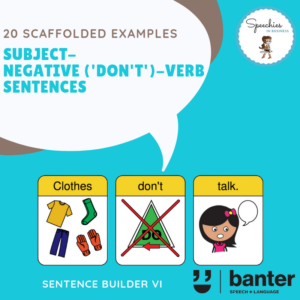
(L126) Subject-Negative (‘Don’t’)-Verb (SNegV Don’t) Sentence Builders
$5.99 including GST -
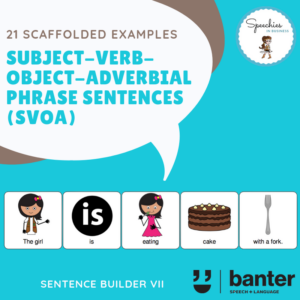
(L145) Subject-Verb-Object-Adverbial Phrase (SVOA) Sentence Builders
$5.99 including GST -
 (D405) Stopping Pack
 (S125) Speech Fluency & Naturalness Practice-Readings for Students and Adults who Stutter: Volume 6 (Famous Essays)
 (S108) Lidcombe Program Starter Series: Resources for Highly Structured Practice: Start Your Engines!
 (R513) High frequency words you need to get right when you write - Volume 1: The Six 'Wh' words
 (S128) Speech Fluency & Naturalness Practice for Students and Adults who Stutter: Volume 7 (Impromptu Speaking Discussion Topics)
 (L264) The No Prep Grammar Builder: Uncontractible Copulas (“Who’s happy?” “She is!”)
 (R416) The Glowing Toad
 (R614) High Frequency Suffixes for Reading and Writing: "-our" or "-or"
 (R509) Think, Then Write Workbook 2: FANBOYS Compound Sentences
 (R422) The Spoiled Boy
 (S114) Stuttering Superhero Cards
 (R810) Book Hacker: How to read a book to understand it quickly
 (S121) Speech Fluency & Naturalness Practice-Readings for Students who Stutter: Volume 2 (Short Poems)
 (R703) Think, Then Write Workbook 4: Paragraph Writing Foundations
 (R414) The Zoo Druid
 (R304) Decoding Polysyllabic Words in Sentences: My Dad Does Several Silly Things
 (R209) CCVC Words in Sentences: Is Stan a Brat?
 (L267) Can I...? Questions (Auditory bombardment)
 (B209) Cycles Approach: /r/ initial Pack
 (B206) Cycles Approach: Velars Pack (/k/ initial and final, /g/ initial)
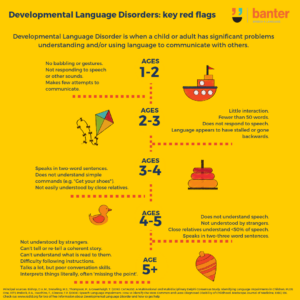 Developmental Language Disorder: Key Red Flags
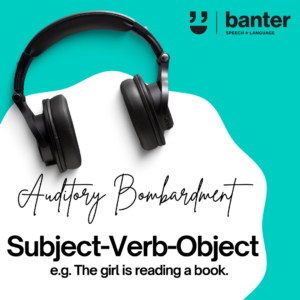 (L121) Subject-Verb-Object (-ing) (Auditory Bombardment)
 (L270) Verbs: Future Tense Verbs: Auxiliary Verb "going to" (e.g. "The girl is going to sing")
 (B208) Cycles Approach: /l/ initial Pack
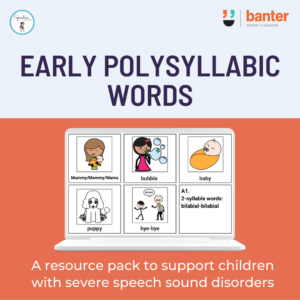 (B210) Early polysyllabic words: a resource pack to support children with severe speech sound disorders
 (L306) "What is it"? Foundations: Objects in Familiar Environments
 Speech Therapy by Telehealth (Video Conferencing): Parent Guidelines
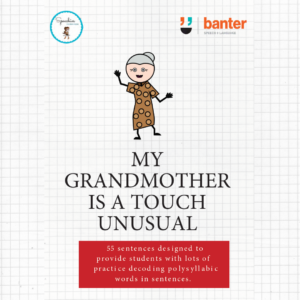 (R306) Decoding Polysyllabic Words in Sentences: My Grandmother Is a Touch Unusual
 (L129) Subject-Verb-Complement (Auditory Bombardment)
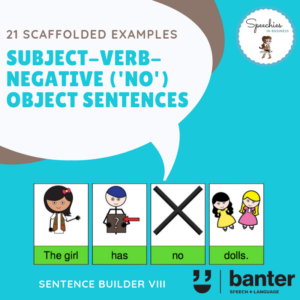 (L123) Subject Verb Negative ("No") Object (SVNegO) Sentences
 No-Prep Basic Reinforcement Pack I
 Carrier Phrases for Speech, Language, Stuttering and Voice Therapy