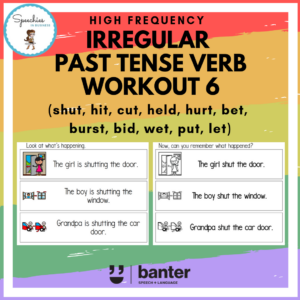


(L137) Verbs: Irregular Past Tense Verb Workout 6: when verbs ending in /t/ do NOT take /əd/
$5.99 including GST
Most people learn the past tense form of regular verbs and the pronunciation rules without needing to be taught about them. However, people learning English as an additional language and/or people with developmental language disorders sometimes don’t pick up these patterns automatically.
In simple terms:
- “ed” is pronounced as /t/ when the sound before it is made without using your voice, e.g. if the base verb ends in an unvoiced sound like /p, s/ or /k/;
- “ed” is pronounced as /d/ when the sound before it is made with your voice “on”, e.g. if the base verb ends in an voiced sound like /b, z/ or /g/; and
- “ed” is pronounced as “ed” (unstressed /əd/) when the sound before it is /d/ or /t/ e.g. “dented”, “needed”, “shouted,” and “wanted”.
As is almost always the case with English, there are some exceptions! Sometimes words ended in /t/ and /d/ do NOT take /əd/ in past tense form.
This 27-page no-preparation Pack 6 is designed to provide people with structured practice of some of the most high frequency exceptions to the /t/ and /d/ rule: shut, hit, held, put, bid, wet, bet, burst, cut, let, hurt.
Description
At around 48-54 months, typically developing children start to use regular past tense verbs, e.g. stopped, played and lifted. Although these verbs are all spelled with an “ed” at the end, the speech sounds used to signal regular past tense vary:
- Sometimes, the “ed” is pronounced as a /t/, e.g. as in “stopped”, “bumped”, “asked”, “baked”, “hopped”, “liked”, and “walked”.
- Sometimes, the “ed” is pronounced as a /d/, e.g. as in “played”, “called”, “carried”, “rolled”, “opened”, “turned”, “showed”.
- Sometimes, the “ed” is pronounced as an “ed” /əd/, e.g. as in “counted”, “lifted”, “shouted”, and “folded”.
Most people learn the past tense form of regular verbs and the pronunciation rules without needing to be taught about them. However, people learning English as an additional language and/or people with developmental language disorders sometimes don’t pick up these patterns automatically. In simple terms:
- “ed” is pronounced as /t/ when the sound before it is made without using your voice, e.g. if the base verb ends in an unvoiced sound like /p, s/ or /k/;
- “ed” is pronounced as /d/ when the sound before it is made with your voice “on”, e.g. if the base verb ends in an voiced sound like /b, z/ or /g/; and
- “ed” is pronounced as “ed” (unstressed /əd/) when the sound before it is /d/ or /t/ e.g. “dented”, “needed”, “shouted,” and “wanted”.
As is almost always the case with English, there are some exceptions! Sometimes words ended in /t/ and /d/ do NOT take /əd/ in past tense form.
This no preparation pack is designed to provide people with structured practice of some of the most high frequency exceptions to the /t/ and /d/ rule:
- shut
- hit
- held
- put
- bid
- wet
- bet
- burst
- cut
- let
- hurt
With both picture cues and orthography, this pack can be used with people of all ages.
For more irregular past tense verb workouts, see our:
- Pack 1 (was, had, did, said, made, ate, came);
- Pack 2 (took, broke, stood, spoke);
- Pack 3 (spent, sent, left, built);
- Pack 4 (knew, drew, grew, threw); and
- Pack 5 (slept, went, meant).

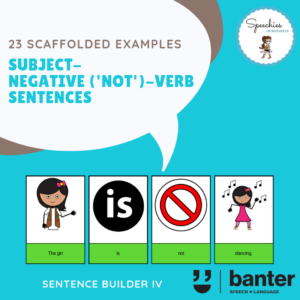 (L124) Subject-Negative ('not')-Verb (SNegV) Sentence Builders
 (S124) Speech Fluency & Naturalness Practice-Readings for Students and Adults who Stutter: Volume 5 (Famous Speeches)
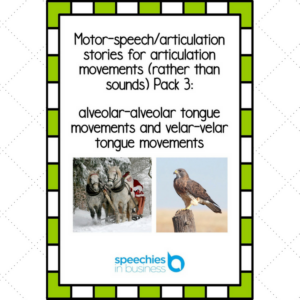 Motor-speech stories for articulation movements pack 3: alveolar-alveolar and velar-velar
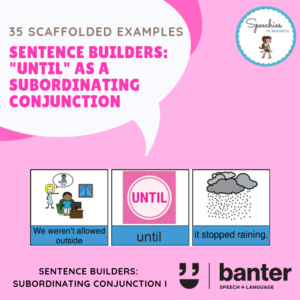
 (L273) Sentence builders: "Although" as a Subordinating Conjunction
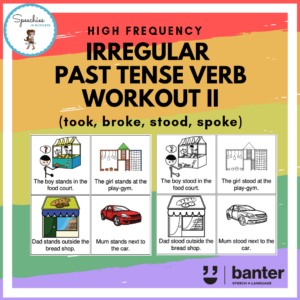 (L133) Verbs: Irregular Past Tense Verb Workout 2 (took, broke, stood, spoke)
 (A100) Sound Cards
 (F508) Zack the Zookeeper: An Alveolar-Velar Story
 (R414) The Zoo Druid
 (L106) Pronouns: He/She - Subjective Pronouns No-Prep Workout Pack
 (L108) Once upon a....whose? A no-preparation resource to focus on the meaning of "whose" questions in context
 (L111) Subject-Verb (-ing) (Auditory bombardment)
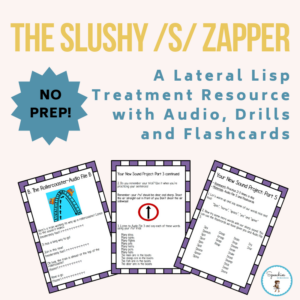 (E411) Slushy /s/ Zapper: A Lateral Lisp Treatment Resource
 (L229) Conjunctions - Because (Auditory bombardment)
 Carrier Phrases for Speech, Language, Stuttering and Voice Therapy
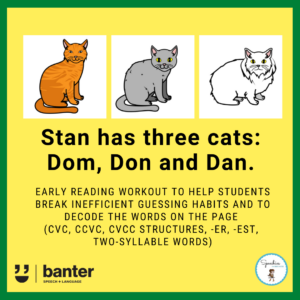 (R215) Early Reading Workout - Stan has three cats: Dom, Don and Dan (CVC, CVCC, CCVC)
 (R701) NAPLAN: Year 3 - Essential Language Convention Skills for NAPLAN (Nouns and Proper Nouns)
 (R509) Think, Then Write Workbook 2: FANBOYS Compound Sentences
 (R209) CCVC Words in Sentences: Is Stan a Brat?
 (F516): Roger Saves the Day? A Palatal Mixed Movement Story
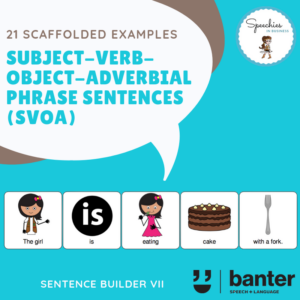 (L145) Subject-Verb-Object-Adverbial Phrase (SVOA) Sentence Builders
 No-Prep Basic Reinforcement Pack I
 (A106) Speech Sound Pack (Initial and Medial) - /h/
 Word Learner
 (A107) Speech Sound Pack (Initial, Medial and Final) - /t/
 (A105) Speech Sound Pack (Initial, Medial and Final) - /n/
 (R413) The Scatter-Slayer Adventures: Book 1 – Don’t Stay! Be Afraid!
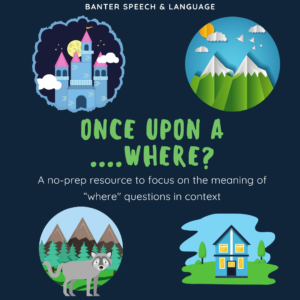 (L115) Once upon a....where? A no-preparation resource to focus on the meaning of "where" questions in context
 (L105) Pronouns: The No Prep Verb & Pronoun Workout (short sentence level)
 (R306) Decoding Polysyllabic Words in Sentences: My Grandmother Is a Touch Unusual
 (R517): Think then Write Workbook 3: Complex Sentences
 (R214) CVCC Words in Sentences: Wendy has zest!
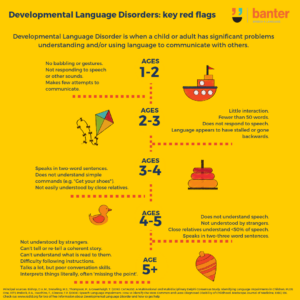 Developmental Language Disorder: Key Red Flags
 (S103) Lidcombe Program for Stuttering: My 10 Favourite Therapy Activities