
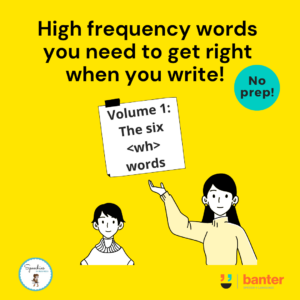
(R513) High frequency words you need to get right when you write – Volume 1: The Six ‘Wh’ words
$10.00 including GST
In this no-prep 47-page resource, we include modules to help students to use the Six <wh> words (who, what, when, where, why, and which) in context by providing the following exercises:
-
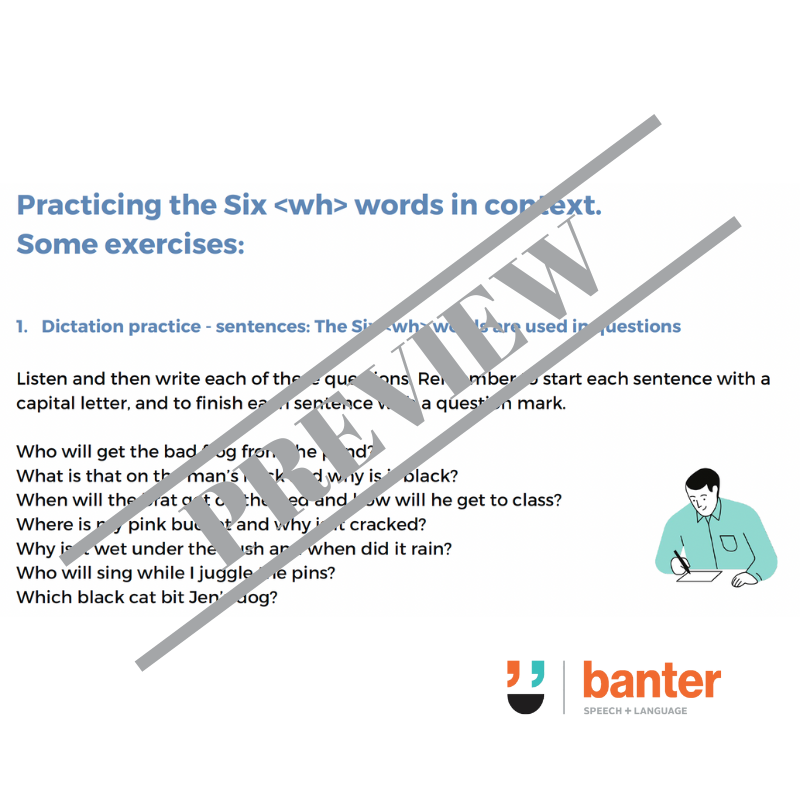
- Dictation practice using the Six <wh> words in questions.
- Dictation practice using the Six <wh> words in sentences to join ideas together.
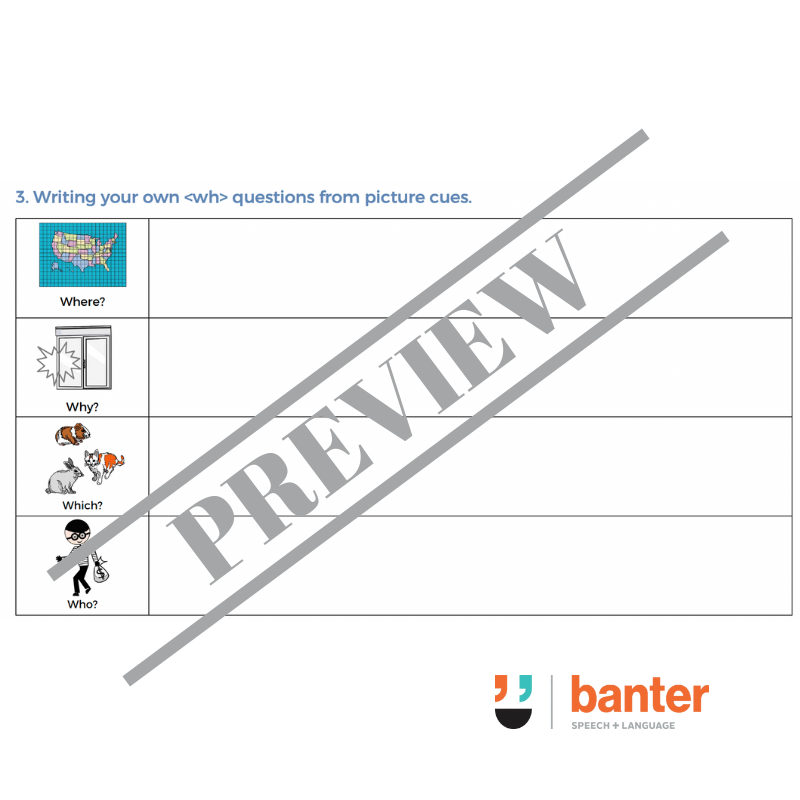
- Writing <wh> questions using picture cues.
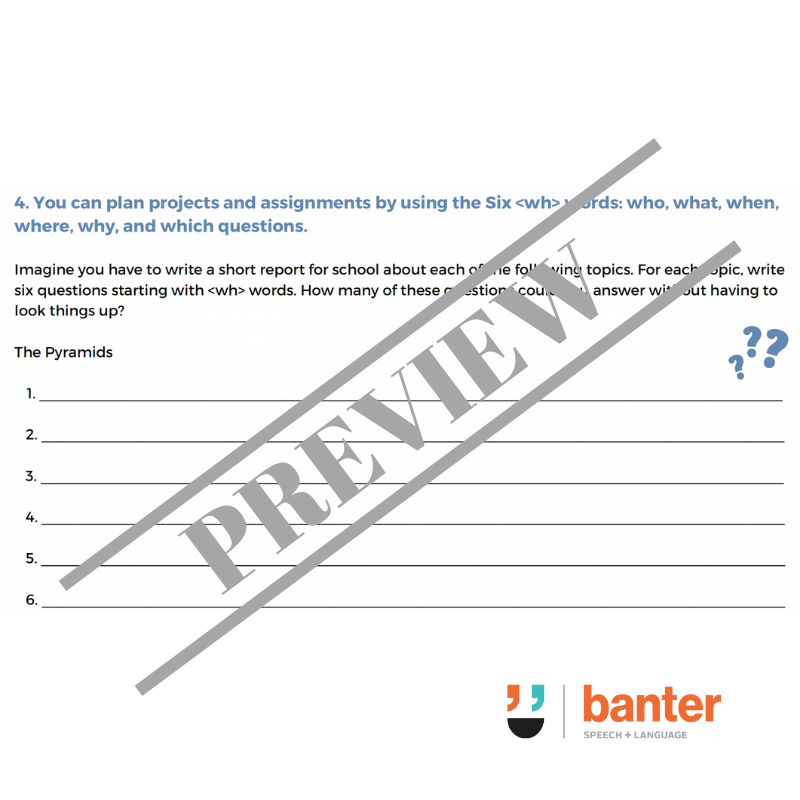
- Writing <wh> questions to plan school reports and assignments about common topics.
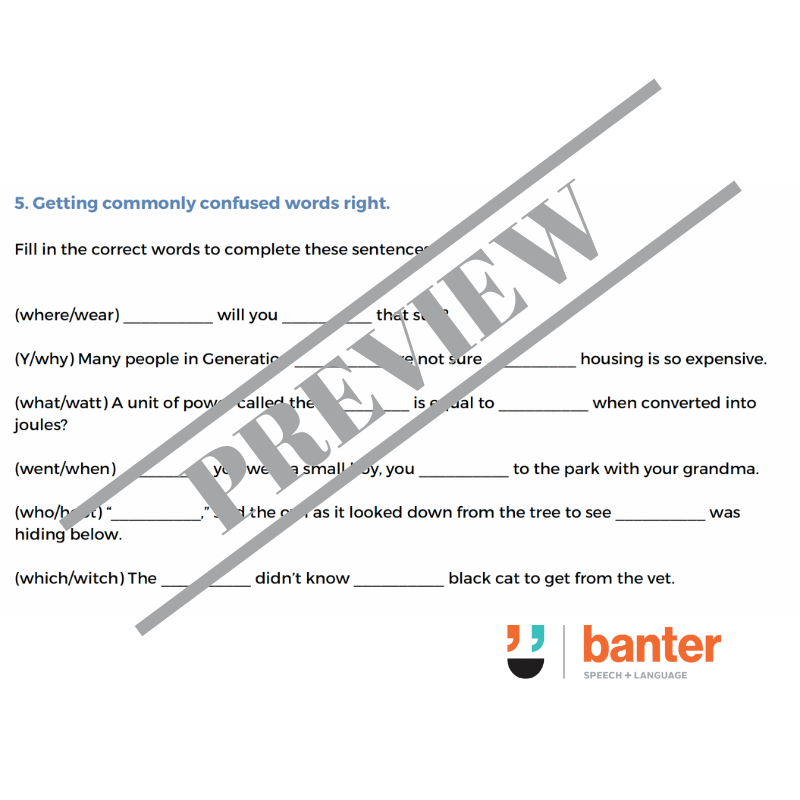
- Practising getting commonly confused words right, e.g. where/wear, what/watt, which/witch.
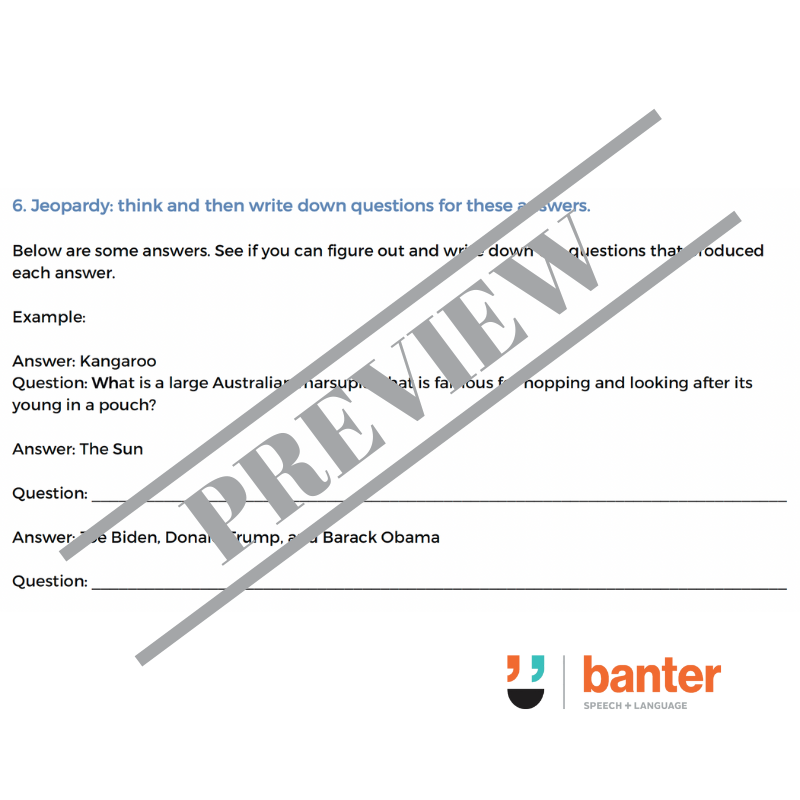
- Writing <wh> questions when provided with answers, similar to Jeopardy.
- Writing a story with the Six <wh> words.
Description
For early spelling, we focus on spelling (encoding) and decoding together using a systematic, sequenced phonics approach. See links at the bottom to relevant articles on our website.
Some older students – including some older students with a history of reading or writing difficulties – benefit from having an adult show them how to spell high frequency words with unusual or unique spellings. This resource is designed to help in relation to <wh> words.
We have structured this resource around the following principles:
-
- Ideally, practice spelling by handwriting the words.
- Use only real words when teaching spelling.
- Sound and write as you spell words – focus on speech sounds (e.g. for /d/, say /d/, not “dee”).
- Focus on decoding left to right all the way through a word, rather than guessing from context, first letter, or pictures.
- If a student makes a mistake, rub it out and correct it straight away.
- Use dictated sentences to put words into context.
- Don’t teach spelling rules. Instead look for statistical patterns and probabilities. For example, almost all syllables (beats) in English have a vowel; the letter <c> is almost always pronounced as /s/ when followed by an <i>, <e>, or <y>.
- Morphology (the study of word forms) and etymology (the study of word origins) can help when introducing high frequency words.
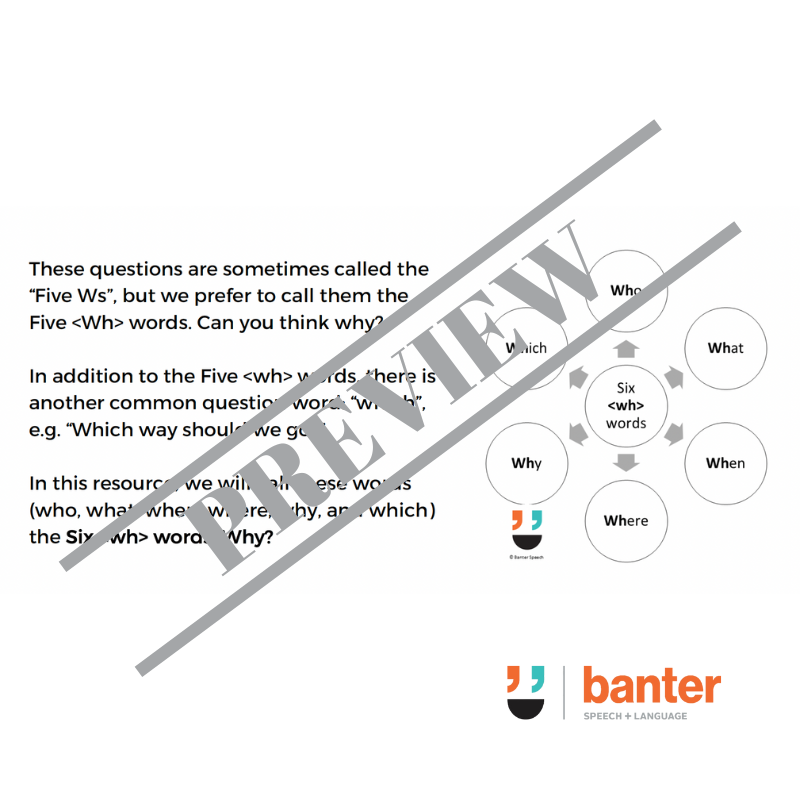
Beginner news reporters are trained to ask five questions to get the information they need to write or tell their news stories. Each of their questions has to start with a <wh> word: Who, What, When, Where, Why.
These questions are sometimes called the “Five Ws”, but we prefer to call them the five <wh> words. In addition to the five <wh> words, there is another common question word: “which”, e.g. “Which way should we go?”.
In this resource, we call these words (who, what, when, where, why, and which) the Six <wh> words.
The Six <wh> words are very common. We use them a lot when we speak, as well as when we write. According to the New General Service List of high frequency vocabulary words, the Six <wh> words are all in the top 200 highest frequency words used in English.
In this no-prep 47-page resource, we include modules to help students to use the Six <wh> words in context by providing the following exercises:
-
- Dictation practice using the Six <wh> words in questions.
- Dictation practice using the Six <wh> words in sentences to join ideas together.
- Writing <wh> questions using picture cues.
- Writing <wh> questions to plan school reports and assignments about common topics.
- Practising getting commonly confused words right, e.g. where/wear, what/watt, which/witch.
- Writing <wh> questions when provided with answers, similar to Jeopardy.
- Writing a story with the Six <wh> words.
We also provide an explanation about the origin of the Six <wh> words and why they are spelled so weirdly.
Further resources:
Susan Godsland taught us a lot about how to teach spelling. You can check our her amazing free spelling information and resources here: Teaching Spelling.
You can read more about our approach to early spelling (focusing on spelling (encoding) and decoding together using systematic, sequenced phonics) at our website:
-
- Too many children can’t read. We know what to do. But how should we do it?
- For beginning readers, where should we start teaching? Phonics, sight words, or both?
- Beginning readers’ brains are not the same as skilled readers’ brains, so stop teaching beginners to read like they are adult experts
- “All models are wrong, but some are useful”: 11 reasons we use the Simple View of Reading to help people with reading difficulties
- For students with spelling difficulties, where should we start?

 (F514): Roger at the Ranch: A Palatal-Palatal Story
 (F515) Roger and the Magic Ring: A Palatal-Velar Story
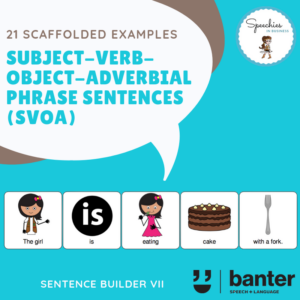 (L145) Subject-Verb-Object-Adverbial Phrase (SVOA) Sentence Builders
 (L230) Sentence builders: "If" as a Subordinating Conjunction
 (F516): Roger Saves the Day? A Palatal Mixed Movement Story
 (R403) Extended Code: I Really, Really Need a Jeep: A Silly 'ee', 'ea' Sentence Story Workout
 (R402) Extended Code: My Brain Plays Every Day in Winter Bay: An 'ay', 'ai' Sentence Story Workout
 (S114) Stuttering Superhero Cards
 (R423) The Scarecrow and Bear Fair in the Land of Nowhere
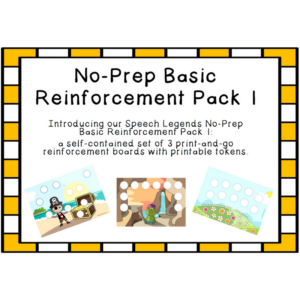 No-Prep Basic Reinforcement Pack I
 (S126) Camperdown Program for Adults who Stutter: Practice Goal Setter
 (C301) Complexity Approach: 3-sound clusters (/spl, str, skw, skr and spr/)
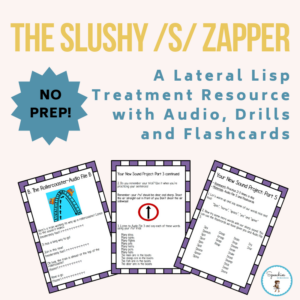 (E411) Slushy /s/ Zapper: A Lateral Lisp Treatment Resource
 (F505) The Theatre Folk: A Dental-Alveolar Story
 (L264) The No Prep Grammar Builder: Uncontractible Copulas (“Who’s happy?” “She is!”)
 (L148) Subject Verb Object Complement (SVOC) Sentences
 Speech Therapy by Telehealth (Video Conferencing): Parent Guidelines
 (R416) The Glowing Toad
 (R414) The Zoo Druid
 (L229) Conjunctions - Because (Auditory bombardment)
 (L129) Subject-Verb-Complement (Auditory Bombardment)
 (R703) Think, Then Write Workbook 4: Paragraph Writing Foundations
Reviews
There are no reviews yet.