


(L317) Verbs: Regular Past Tense Verbs 4: when “ed” is pronounced as /t/, /d/ and /əd/
$5.99 including GST
This 29-page no preparation pack is designed to provide people with structured practice using frequently used regular past tense verbs. In this pack, we mix up examples to practice “ed” pronounced as /d/, /t/ and /əd/. With both picture cues and orthography, this pack can be used with people of all ages.
Description
At around 48-54 months, typically developing children start to use regular past tense verbs, e.g. stopped, played and lifted. Although these verbs are all spelled with an “ed” at the end, the speech sounds used to signal regular past tense vary:
- Sometimes, the “ed” is pronounced as a /t/, e.g. as in “stopped”, “bumped”, “asked”, “baked”, “hopped”, “liked”, and “walked”.
- Sometimes, the “ed” is pronounced as a /d/, e.g. as in “played”, “called”, “carried”, “rolled”, “opened”, “turned”, “showed”.
- Sometimes, the “ed” is pronounced as an “ed” /əd/, e.g. as in “counted”, “lifted”, “shouted”, and “folded”.
Most people learn the past tense form of regular verbs and the pronunciation rules without needing to be taught about them. However, people learning English as an additional language and/or people with developmental language disorders sometimes don’t pick up these patterns automatically. In simple terms:
- “ed” is pronounced as /t/ when the sound before it is made without using your voice, e.g. if the base verb ends in an unvoiced sound like /p, s/ or /k/;
- “ed” is pronounced as /d/ when the sound before it is made with your voice “on”, e.g. if the base verb ends in an voiced sound like /b, z/ or /g/; and
- “ed” is pronunced as “ed” (unstressed /əd/) when the sound before it is /d/ or /t/ e.g. “dented”, “needed”, “shouted,” and “wanted”.
This 29-page no preparation pack is designed to provide people with structured practice using frequently used regular past tense verbs. In this pack, we mix up examples to practice “ed” pronounced as /d/, /t/ and /əd/. With both picture cues and orthography, this pack can be used with people of all ages.
For more regular past tense verbs, see our Regular Past Tense Verbs 1: when “ed” is pronounced as /t/, Regular Past Tense Verbs 2: when “ed” is pronounced as /d/ and Regular Past Tense Verbs 3: when “ed” is pronounced as /əd/.

 (L273) Sentence builders: "Although" as a Subordinating Conjunction
 (L226) Sentence builders: "Because" as a Subordinating Conjunction
 (R414) The Zoo Druid
 (A103) Speech Sound Pack (Initial, Medial and Final) - /m/
 (A104) Speech Sound Pack (Initial, Medial and Final) - /d/
 (R419) The Shark Arcade
 (R703) Think, Then Write Workbook 4: Paragraph Writing Foundations
 (A105) Speech Sound Pack (Initial, Medial and Final) - /n/
 Complex Cluster Targets for use with a Cycles Approach, Complexity Approach or Contrastive Approach
 (R415) Attack of the Eel Beast
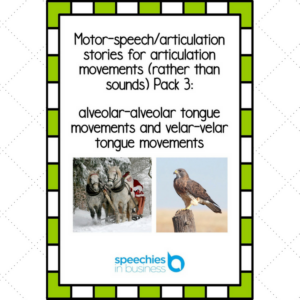 Motor-speech stories for articulation movements pack 3: alveolar-alveolar and velar-velar
 (L230) Sentence builders: "If" as a Subordinating Conjunction
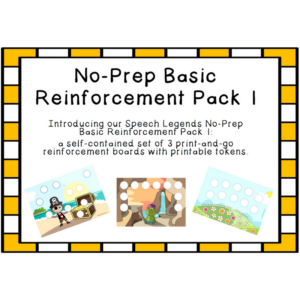 No-Prep Basic Reinforcement Pack I
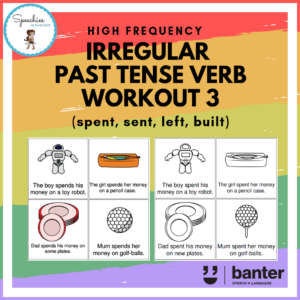 (L134) Verbs: Irregular Past Tense Verb Workout 3 (spent, sent, left, built)
 (R806) Think Then Write Workbook 5: Multi-Paragraph Information Report Writing Foundations
 (C302) Complexity Approach: True Clusters with a Sonority Difference of 2 (/sm/ and /sn/)
 (F519) Advanced Speech Sound Exercises: Discourse Level Exercises - Alveolar Speech Sounds
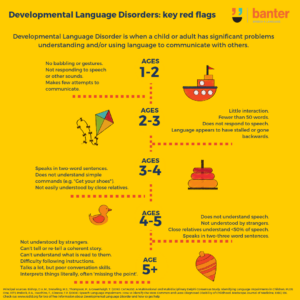 Developmental Language Disorder: Key Red Flags
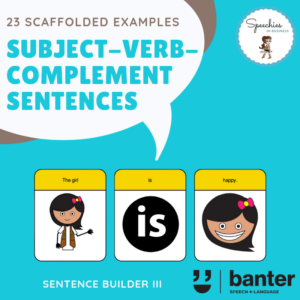 (L128) Subject-Verb-Complement (SVC) Sentence Builders
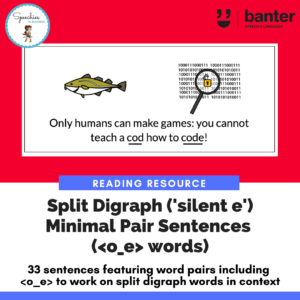 (R310) Reading Resource: Split Digraph ('silent e') Minimal Pair Sentences: o_e words
 Word Learner
 (R306) Decoding Polysyllabic Words in Sentences: My Grandmother Is a Touch Unusual
 (C303) Complexity Approach: True Clusters with a Sonority Difference of 3 (/fl, sl, fr, shr and thr/)
 (R509) Think, Then Write Workbook 2: FANBOYS Compound Sentences
 (C301) Complexity Approach: 3-sound clusters (/spl, str, skw, skr and spr/)
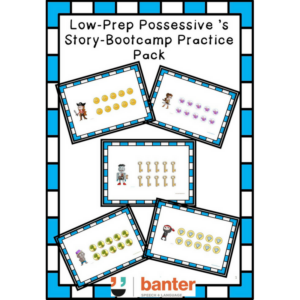 (L263) Low-Prep Possessive ’s Story-Bootcamp Practice Pack
